Explore the world of swimming
Swimming is one of those rare activities that feels playful and serious at the same time. It can build fitness, teach survival skills, ease stress, and open doors to recreation, competition, and lifelong health. Whether you enter a quiet pool at dawn or face the shifting surface of a lake, the water demands patience, rhythm, and respect. This article explains why swimming matters, how it works, and what different kinds of swimmers can gain from it.
Outline
- The first section explains why swimming remains relevant for health, fitness, mobility, and mental balance in everyday life.
- The second section compares the major strokes and shows how technique changes speed, efficiency, and comfort in the water.
- The third section explores training structure, beginner progress, and the small habits that turn random laps into purposeful practice.
- The fourth section covers pools, open water, gear, and the safety decisions that protect swimmers at every level.
- The final section brings everything together with a practical conclusion for readers who want to make swimming part of their routine.
Why Swimming Matters: Health, Movement, and the Human Connection to Water
Swimming holds a special place among physical activities because it blends exercise, skill, and practical life value. Many sports develop strength or endurance, but swimming adds another dimension: it teaches people how to move safely in an environment the human body does not naturally control. That combination makes it relevant far beyond fitness trends. A person may start swimming to lose weight, recover from injury, manage stress, or simply keep up with children at the beach, yet all of those paths lead to a useful and lasting capability.
From a physical standpoint, swimming is often praised as a full-body workout, and that description is well earned. The arms pull, the legs kick, the core stabilizes, and the lungs work steadily to support repeated effort. Because water supports body weight, swimming is usually gentler on the joints than high-impact exercise such as running. This is one reason it is frequently recommended for older adults, people returning to activity after a long break, and individuals managing certain forms of joint discomfort. At the same time, “low impact” does not mean “low challenge.” A hard swim session can raise the heart rate quickly and leave even fit people humbled by the end of a set.
Health organizations commonly advise adults to accumulate at least 150 minutes of moderate aerobic activity per week, and swimming can contribute directly to that goal. Depending on stroke choice, intensity, and body size, an hour of swimming may use several hundred calories. Competitive swimmers and experienced lap swimmers often burn considerably more because efficiency lets them sustain stronger efforts over time. The real advantage, however, is not only calorie use. Swimming can improve cardiovascular endurance, help preserve muscle tone, and support mobility through repeated controlled movement.
- It develops endurance without constant pounding on the knees and hips.
- It strengthens breath control in a way many land sports do not.
- It can be recreational, therapeutic, social, or competitive.
- It teaches water confidence, which has genuine safety value.
Mental benefits also help explain swimming’s enduring appeal. The sound of splashing fades into rhythm, breathing settles into pattern, and the mind often narrows its attention to the next wall, the next kick, the next smooth exhale. For some people, a swim feels like active meditation with chlorine in the air. For others, it is a structured challenge that offers clear progress. In both cases, swimming rewards consistency, and that is a powerful reason it remains one of the world’s most respected activities.
The Four Main Strokes: Technique, Rhythm, and What Makes Each One Different
To watch skilled swimmers is to see four different conversations with water. Each stroke has its own rhythm, body position, breathing pattern, and purpose. Front crawl, backstroke, breaststroke, and butterfly are all legitimate ways to move, but they do not demand the same strengths or offer the same experience. Understanding those differences helps beginners learn more intelligently and helps experienced swimmers choose the right tool for the session in front of them.
Front crawl, often called freestyle in competition, is generally the fastest and most efficient stroke over distance. The body stays long and horizontal, the arms alternate, and the kick helps stabilize as much as propel. Good crawl depends on timing: rotating through the torso, entering the hand cleanly, catching the water early, and breathing without lifting the head too high. New swimmers often think speed comes from frantic effort, but crawl teaches the opposite lesson. Tension slows everything down. Smooth swimmers look almost quiet because they waste less motion.
Backstroke reverses the orientation but keeps many of the same principles. Swimmers lie on the back, rotate through the shoulders and hips, and maintain a steady alternating arm pattern. Because the face stays above water, some beginners find backstroke less intimidating than crawl. It can also reveal technical flaws, since poor alignment quickly causes zigzagging. The challenge here is direction and balance. Without a lane line or ceiling markers, a novice backstroker may drift like a shopping cart with one stubborn wheel.
Breaststroke is slower for most swimmers, yet it remains popular because its timing feels more intuitive to many learners. The pull, breath, kick, and glide occur in a clear sequence. It is often easier to sight forward in breaststroke, which helps recreational swimmers stay aware of surroundings. Still, it is not a “lazy” stroke when done well. Efficient breaststroke demands precise timing and a strong whip kick. If the kick spreads too wide or the glide disappears, the stroke turns costly very quickly.
Butterfly is the most physically demanding of the four. Both arms recover together, the body undulates, and the kick comes from a coordinated dolphin motion. When it is done well, butterfly looks like controlled power; when it falls apart, it feels like wrestling the water itself. It is usually taught after basic comfort has been established in other strokes.
- Front crawl: fastest and versatile for fitness.
- Backstroke: useful for posture, rotation, and confidence.
- Breaststroke: technical, controlled, and popular with recreational swimmers.
- Butterfly: powerful, advanced, and highly demanding.
Across all strokes, the big idea is the same: technique shapes outcome. Better position and timing often beat brute force, and that is one of swimming’s most fascinating truths.
From Random Laps to Real Progress: How Training Builds Skill and Endurance
Many people begin swimming with a simple plan: get in, do a few lengths, get tired, and call it a workout. That approach is not useless, but it rarely produces steady progress. Swimming responds best to intention. Because water creates constant resistance, even small technical errors multiply over time. A thoughtful session, by contrast, can improve endurance, efficiency, and confidence all at once. The key is to train with structure rather than relying only on effort.
For beginners, progress usually starts with comfort and breathing. Before speed matters, a swimmer needs to exhale underwater, float with control, and travel short distances without panic. Once that foundation exists, lessons or guided practice can add stroke mechanics. Early gains are often dramatic. A small change in head position, a calmer kick, or a better timing of the breath can make swimming feel less like survival and more like movement. That is why coaching matters so much in this sport. On land, people can often “muscle through” poor form. In water, inefficiency gets exposed immediately.
Intermediate swimmers often benefit from simple workout design. Instead of swimming nonstop until fatigue takes over, they can divide a session into parts: warm-up, drill work, main set, and easy recovery. This adds purpose and makes improvement easier to measure. An example session might include a relaxed 200-meter warm-up, four short drills focusing on breathing or body rotation, a main set of repeated 50s or 100s with rest, and a gentle cooldown. That structure is common because it works. It teaches pacing, preserves form, and prevents every swim from becoming the same medium-hard blur.
- Warm-up prepares the body and raises awareness of technique.
- Drills isolate one skill at a time, such as catch, kick, or balance.
- Main sets develop endurance, speed, or race-specific control.
- Cooldown supports recovery and reinforces smoother movement.
Advanced swimmers push training further with interval sets, pace clocks, stroke counts, and race strategies. They may track how many strokes are taken per length, compare split times, or adjust effort zones across a week. Yet the principle remains familiar: improvement comes from repeating quality movement under manageable stress. Even elite athletes spend large portions of training refining basics.
There is also a practical side to training culture. Good lap etiquette matters in shared pools. Swimmers should rest at corners, leave space on push-off, and understand whether a lane is being split or circle-swum. These details seem minor until a crowded lane turns chaotic. Swimming may feel solitary, but progress often happens in a social environment where awareness and courtesy keep everyone moving.
In the end, successful training is less about punishment and more about rhythm. The swimmer who returns regularly, pays attention, and builds from session to session usually advances farther than the one who sprints wildly for a week and disappears for a month.
Pools, Open Water, Gear, and Safety: The Environment Shapes the Swim
Where you swim changes almost everything. A bright indoor pool with marked lanes offers predictability, while a river, lake, or sea introduces variables that no tiled floor can promise to manage. Each environment has its own rewards, and each asks different questions of the swimmer. Recognizing those differences is essential not just for performance, but for safety.
Pools are ideal for skill development because they are controlled spaces. Distances are measured, lanes reduce traffic confusion, and features such as flags, wall markings, and lifeguard supervision provide structure. Standard competition pools are commonly 25 meters, 25 yards, or 50 meters long, allowing swimmers to compare times and workouts with some consistency. For beginners, this stable setting removes many unknowns. A swimmer can focus on breathing, kicking, and stroke timing without also dealing with waves, poor visibility, or shifting temperatures.
Open water has a different magic. Lakes and oceans replace straight black lines with texture, weather, currents, and changing light. Many swimmers love the freedom of it. The experience can feel expansive, almost cinematic, as if the workout has borrowed the horizon. But open water is never just a bigger pool. Navigation matters. So does water temperature, boat traffic, wind, and entry or exit difficulty. Even strong pool swimmers can be surprised by how disorienting open water feels at first.
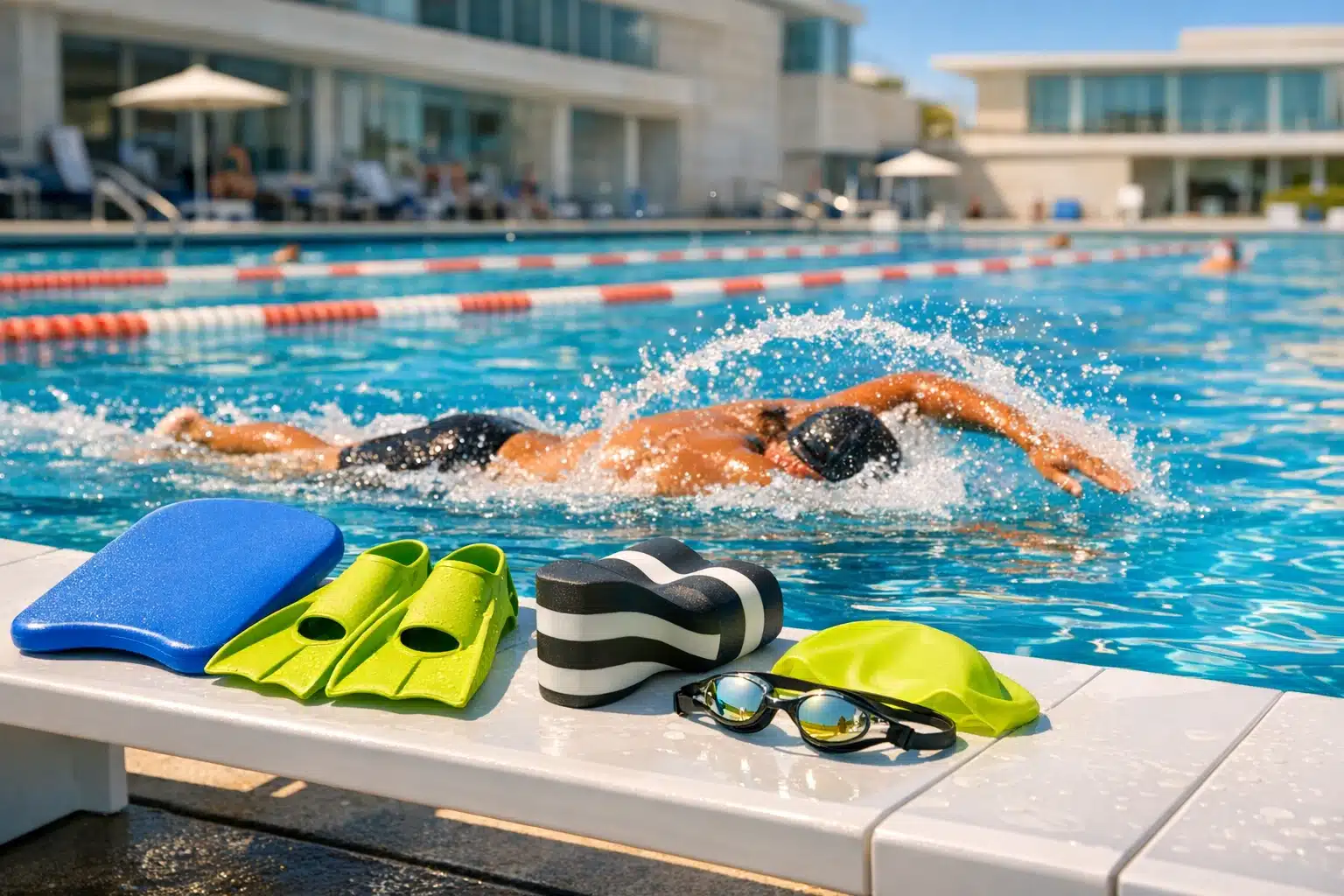
Basic equipment can make swimming more comfortable and productive, but gear should support skill rather than replace it. Goggles improve visibility and reduce eye irritation. Swim caps help with streamlining and hair management. Kickboards, pull buoys, and fins are useful training tools when used deliberately. Paddles can build strength and awareness, though they should be introduced carefully to avoid shoulder strain. For open water, a brightly colored cap and, in some settings, a tow float can increase visibility.
- Never assume open water behaves like a pool.
- Check weather, currents, and water quality before entering.
- Swim with a partner or in supervised conditions whenever possible.
- Respect personal limits, especially in cold water.
- Children should always be actively supervised near water.
Safety deserves emphasis because swimming competence exists on a spectrum. Someone may be comfortable in a shallow lane and still be unprepared for depth, fatigue, or panic in another setting. Learning floating, treading water, safe entry, and how to respond calmly to difficulty is just as important as learning strokes. In that sense, the most valuable swimmer is not always the fastest one. It is often the person who reads the environment well, makes careful decisions, and understands that confidence in water must be earned rather than assumed.
Conclusion for Everyday Swimmers: How to Make the Water Part of Real Life
If you are the kind of reader who is curious about swimming but unsure where to begin, the good news is that this activity does not require a dramatic entrance. You do not need to picture yourself charging through an Olympic final or slicing across a rough bay at sunrise. For most people, swimming starts with smaller, more useful goals: becoming comfortable in deep water, completing a few steady lengths, joining a beginner class, or finding one form of exercise that does not feel punishing. Those goals are modest only on paper. In real life, they can change how people move, relax, and trust themselves.
For adults returning to exercise, swimming offers a forgiving but serious option. It can challenge the heart and lungs without the repetitive impact that discourages some beginners. For parents, it is a reminder that water familiarity is not merely recreational; it is a life skill worth passing on carefully. For older readers, swimming can support mobility and routine when some other sports become less practical. For ambitious athletes, it remains a technical frontier where efficiency is endlessly refined. In other words, swimming does not belong to one age group or one personality. It scales beautifully across different lives.
The best next step is usually a practical one. Choose a nearby pool, confirm beginner-friendly hours, and decide on a realistic schedule. One or two sessions per week can be enough to build momentum. If technique feels confusing, seek instruction early. A short course or a few focused lessons can save months of frustration because swimming punishes guesswork more than many other activities do. Progress may come unevenly at first, but it does come. One week you struggle with breathing; a few weeks later the same length feels calm and manageable.
- Start with consistency rather than intensity.
- Learn safety skills alongside formal strokes.
- Use simple goals that can actually fit your week.
- Pay attention to comfort, technique, and recovery.
What makes swimming so rewarding is that it gives back in several currencies at once. It can improve fitness, lower stress, build discipline, and create genuine confidence around water. It can be social in a club, peaceful in a quiet lane, or adventurous in open water. Most of all, it teaches a memorable lesson: progress often looks smoother, not louder. If you are ready to begin or ready to return, the water is not asking for perfection. It is asking for patience, respect, and the willingness to keep showing up.