Explore the world of swimming
Introduction
Swimming is one of those rare activities that feels playful and serious at the same time, welcoming beginners while still testing elite athletes. It strengthens the heart, trains nearly every major muscle group, and teaches a practical safety skill that matters well beyond the edge of a pool. From school lessons to Olympic races and quiet laps before sunrise, swimming fits many ages, goals, and routines. That wide reach is exactly why it deserves a closer look.
Outline
This article explores five connected parts of swimming. First, it explains why swimming remains valuable as exercise, recreation, and a life skill. Second, it breaks down the science of movement in water and compares the main strokes. Third, it looks at learning, training, and equipment in a realistic way. Fourth, it compares pool swimming with open-water swimming, including safety and mindset. Fifth, it shows how people at different life stages can make swimming part of a lasting routine.
Why Swimming Matters: Fitness, Safety, and Everyday Relevance
Swimming matters because it sits at the crossroads of health, confidence, and practical ability. Many sports improve fitness, but fewer also teach a skill that can protect life in a real-world emergency. That alone gives swimming a special place in schools, community programs, and family routines. A child who learns to float, kick, and breathe rhythmically is not just learning a sport; that child is gaining calm in an environment that can feel unpredictable. For adults, swimming often becomes a rare form of exercise that is both demanding and forgiving. Water supports body weight, which reduces impact on joints, making it especially attractive for people who find running or high-impact training uncomfortable.
From a fitness perspective, swimming is a full-body activity. The arms pull, the legs drive, the core stabilizes, and the lungs work in a disciplined pattern. Public health guidance often recommends at least 150 minutes of moderate aerobic activity each week for adults, and swimming can contribute meaningfully to that target. Depending on pace and stroke, it can be gentle enough for recovery days or intense enough to push cardiovascular endurance. That flexibility makes it unusual. A relaxed breaststroke session feels very different from a hard freestyle interval set, yet both belong to the same world.
Swimming also supports mental well-being in ways many people notice quickly. The sound of bubbles, the lane line sliding past, and the steady count of strokes can create a focused state that feels almost meditative. Unlike activities filled with impact, noise, or constant tactical decisions, lap swimming often strips the workout down to breath, movement, and rhythm. For some people, that simplicity is the whole charm.
Its relevance reaches beyond fitness culture. Swimming can be social, competitive, therapeutic, or simply practical during hot weather and travel. Consider the range:
• children learning water safety
• athletes cross-training after injury
• older adults seeking low-impact movement
• triathletes building endurance
• families using local pools as affordable recreation
That variety explains why swimming never belongs to one narrow audience. It can be serious without becoming exclusive, and relaxing without becoming trivial. Few activities manage that balance so naturally.
How Swimming Works: Buoyancy, Breathing, and the Four Main Strokes
At first glance, swimming can look simple: enter the water, move your arms, kick your legs, and go forward. In practice, it is a technical skill shaped by physics and body awareness. Water is far denser than air, which means every movement meets resistance. That resistance is useful because it helps build strength, but it also punishes poor technique. A swimmer with perfect balance and smooth timing can glide with surprising efficiency, while a stronger but less coordinated swimmer may tire quickly. This is one reason beginners often discover that swimming is less about force than about control.
Buoyancy is the first major concept. Human bodies do not float like identical objects; body composition, lung capacity, and relaxation all influence how a person sits in the water. Many new swimmers struggle not because they are weak, but because they tense up. Tight shoulders, lifted heads, and rushed breathing can drag the hips downward and create extra resistance. Good instruction often starts with floating, exhaling into the water, and finding a long body line. Once that line is stable, propulsion becomes easier.
Breathing is the next challenge. On land, breathing is automatic and generous. In the pool, it becomes timed, limited, and technical. Swimmers usually exhale underwater and inhale quickly when the mouth clears the surface. That rhythm matters. Holding the breath tends to increase tension and disrupt timing. Efficient breathing, by contrast, helps the stroke stay smooth.
The four main competitive strokes each solve the problem of movement differently:
• Freestyle uses alternating arm recovery and flutter kick, and it is generally the fastest stroke.
• Backstroke mirrors some freestyle mechanics while keeping the face above water, which changes orientation and breathing demands.
• Breaststroke uses a pull-and-kick pattern with a glide phase, often making it easier for beginners to understand but harder to master efficiently.
• Butterfly is the most physically demanding for many swimmers, combining symmetrical arm action with a wave-like body motion and dolphin kick.
Comparing the strokes reveals how varied swimming can be. Freestyle rewards efficiency and rhythm, backstroke demands spatial awareness without visual contact with the pool floor, breaststroke highlights timing, and butterfly exposes flaws instantly because it wastes no movement. Even turns and starts reshape performance. In competitive pools, long-course pools are 50 meters and short-course pools are commonly 25 meters, and that difference changes pacing because more turns can either help momentum or break flow. Seen closely, swimming is not one skill but a family of related techniques, each with its own personality.
Learning to Swim and Training Well: From First Lessons to Structured Workouts
Learning to swim successfully usually starts with modest goals, not dramatic ones. Many beginners assume progress means swimming long distances right away, but early improvement is often quieter than that. It may begin with putting the face in the water without panic, floating on the back for ten calm seconds, or exhaling steadily instead of rushing to the wall. Those small wins matter because swimming builds from comfort as much as from strength. A person who feels safe in the water learns faster than a person who fights it every second.
Formal lessons help because they reduce guesswork. Instructors typically teach posture, breathing, kicking, and simple propulsion in a sequence that makes sense biomechanically. They also spot habits that swimmers rarely notice on their own, such as crossing the hands in front, bending the neck too sharply to breathe, or kicking from the knees instead of the hips. Video analysis can be useful at higher levels, but even basic feedback changes outcomes quickly. The pool is an honest teacher: small technical errors become large energy costs.
Once a swimmer can complete relaxed lengths, training becomes more structured. Instead of swimming until tired, many people benefit from organized sets with rest intervals. A session might include a warm-up, drills, a main aerobic set, and an easy cool-down. That structure creates purpose. It also makes progress measurable. Swimmers can track pace per 100 meters, stroke count, rest time, or total weekly distance. Improvement in swimming often looks less dramatic than in lifting weights, but it is deeply satisfying because the body begins to feel smoother, quieter, and more efficient in the water.
Useful equipment can support training without replacing technique:
• Goggles improve comfort and visibility.
• A kickboard isolates lower-body work.
• Pull buoys shift emphasis toward upper-body mechanics.
• Fins can help body position and ankle flexibility.
• Pace clocks or waterproof watches make interval training easier.
Good training also includes restraint. Shoulder irritation, neck tension, and overuse can appear when swimmers increase volume too quickly or repeat poor mechanics under fatigue. Rest, mobility work, and varied sessions matter. So does pool etiquette: circle swimming, respecting lane speed, and leaving space at the wall keep training safer and more pleasant. In the end, strong swimming is not built by thrashing harder. It grows from repetition, feedback, patience, and the gradual conversion of effort into ease.
Pool Swimming and Open Water: Two Environments, Two Different Experiences
Pool swimming and open-water swimming share the same foundation, yet they can feel like different sports. In a pool, the environment is controlled. Lane lines organize traffic, walls break the distance into manageable pieces, and the water temperature is usually predictable. That stability makes pools ideal for learning, testing technique, and following exact workouts. Coaches can set intervals, compare splits, and refine details with precision. For many swimmers, the pool is a laboratory where progress becomes visible one repeat at a time.
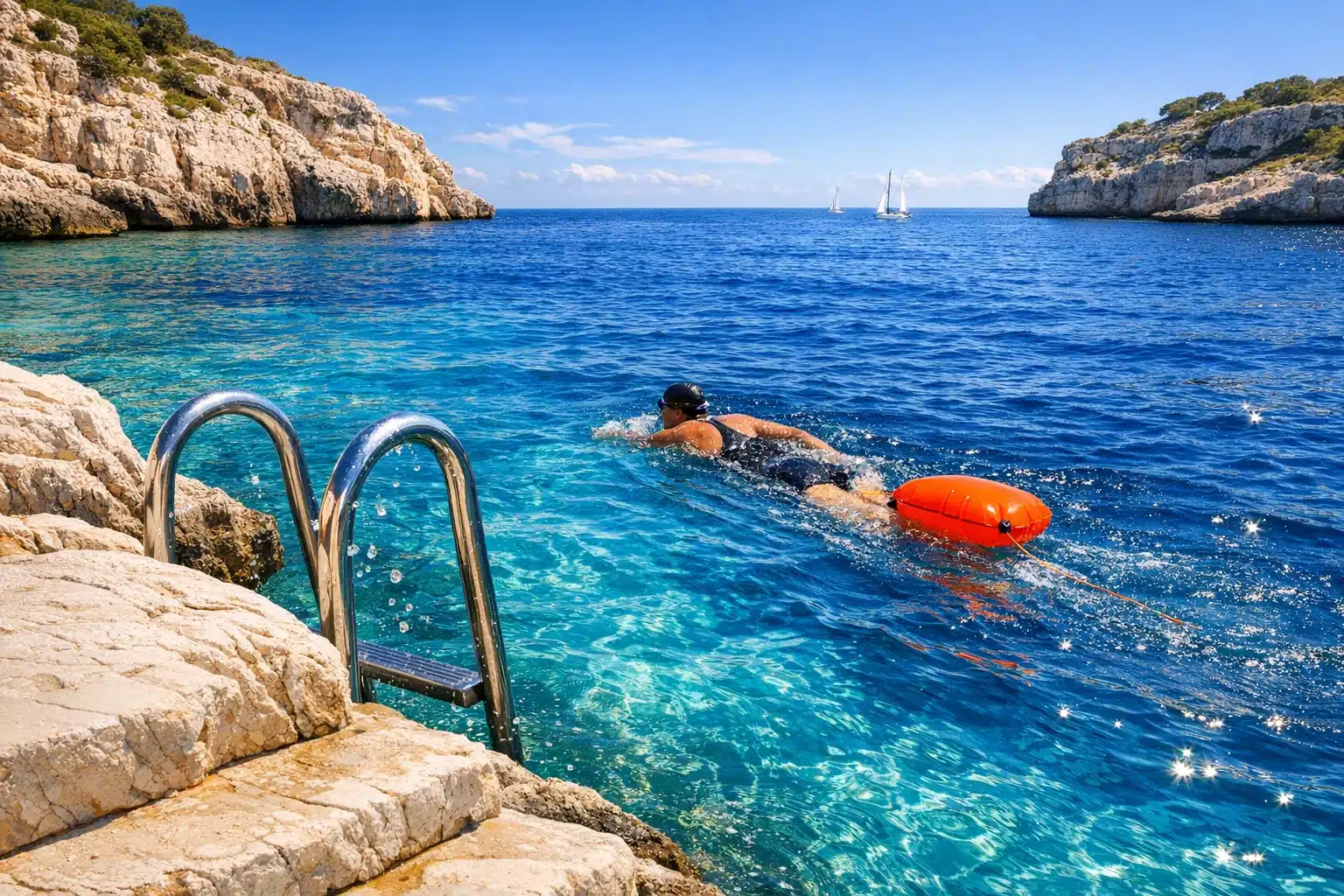
Open water changes the story completely. Lakes, oceans, rivers, and reservoirs introduce variables that no tiled lane can imitate. There may be currents, waves, wind, uneven visibility, and water temperatures that shift unexpectedly. Instead of pushing off a wall every 25 or 50 meters, the swimmer must sustain movement continuously. Sighting becomes essential, meaning the swimmer periodically lifts the eyes forward to stay on course. That small action can disturb body position, which is why open-water skill is not just pool fitness transferred outdoors. It requires adaptation.
The psychological contrast is just as striking. Pools offer reassurance through structure. You can count lengths, glance at a clock, and stop at the wall within seconds. Open water can feel expansive and even poetic, but it can also feel mentally demanding. The bottom may disappear, landmarks may seem distant, and conditions may change during the swim. For some people, this uncertainty is thrilling. For others, it is a strong reason to begin cautiously and with support.
Safety is where the comparison becomes especially important:
• Pool swimmers should still respect fatigue, lane traffic, and local rules.
• Open-water swimmers should check conditions, wear visible gear, and avoid swimming alone.
• Cold water can impair coordination more quickly than many expect.
• Boats, tides, and weather add risks that do not exist in standard lap lanes.
Neither environment is inherently better; they simply reward different strengths. Pools favor consistency, exact pacing, and technique repetition. Open water rewards adaptability, navigation, and calm under changing conditions. Competitive swimmers, triathletes, and recreational swimmers often benefit from both. A pool can sharpen form like a finely tuned instrument, while open water reminds the swimmer that water is not only a training medium but a living landscape. In one setting, you chase numbers. In the other, you learn to read the world around you stroke by stroke.
Swimming for Life: Different Ages, Different Goals, and a Practical Conclusion
One of swimming’s greatest strengths is that it can evolve with the person doing it. For children, swimming often begins with trust and water familiarity. Early lessons focus on floating, breath control, and basic movement, but the deeper value is confidence. A child who becomes comfortable in the water gains more than recreation; that child gains a lifelong skill with clear safety benefits. For teenagers, swimming can become social and competitive, offering structure, discipline, and a measurable way to improve. Practices teach more than speed. They teach pacing, resilience, and the strangely useful ability to keep going when the wall feels very far away.
Adults often come to swimming for different reasons. Some return after years away because they want low-impact cardio. Others use it as cross-training for cycling, running, or team sports. Many are drawn to the mental reset it offers after a day spent at desks, in traffic, or in front of screens. Swimming asks for presence. You cannot answer emails during a flip turn, and that is part of the appeal. Older adults may value swimming for mobility, circulation, and manageable resistance, especially when joint comfort matters more than explosive performance. Adaptive swimming also opens the door for people with different physical needs, showing how flexible the activity can be when facilities and coaching are inclusive.
If you are wondering how to begin or restart, the smartest path is usually the simplest:
• choose a realistic schedule, even if it is only two sessions a week
• focus on technique before volume
• use lessons or feedback if possible
• increase distance gradually
• treat consistency as more important than heroic single workouts
The target audience for swimming is almost everyone, but the reasons differ. A parent may value safety, a beginner may want confidence, a busy professional may need stress relief, and a masters athlete may chase efficient speed. The common thread is that swimming gives back what you patiently put into it. It does not usually reward chaos, but it responds beautifully to steady practice.
Conclusion for Readers Ready to Get in the Water
If you are curious about swimming, you do not need to start with ambition large enough to fill an Olympic pool. Start with one lesson, one calm lane session, or one short visit to the water with a clear purpose. Learn how your body floats, how your breathing settles, and how technique saves energy. In time, swimming can become exercise, skill, therapy, recreation, and quiet confidence all at once. That is the real invitation of the sport: not merely to move through water, but to feel more capable every time you do.