Explore the world of swimming
Introduction and Outline
Swimming sits at a rare crossroads where survival skill, sport, therapy, and pure enjoyment meet. It asks for rhythm more than brute force, rewards patience as much as speed, and gives children, adults, and older people a way to move with confidence. From busy community pools to quiet lakes at sunrise, water keeps offering the same invitation: learn its language, and it can change how you think about effort, balance, and progress.
This article follows a simple path so the subject feels easy to enter and rewarding to explore.
• First, it explains why swimming matters for health, fitness, and everyday well-being.
• Next, it breaks down the four competitive strokes and the technical habits that shape efficient movement.
• Then, it looks at training structure, useful equipment, and practical ways to improve.
• Finally, it turns to safety, swimming culture, and a concluding message for readers who want to begin or return with purpose.
Few activities carry such a broad range of value. A child may first meet swimming as a life skill, a student may discover it through school lessons, an adult may choose it after an injury, and an athlete may pursue it for performance. Unlike many forms of exercise that demand impact tolerance, swimming uses buoyancy to soften the load on joints while still providing meaningful resistance. Water is far denser than air, so even simple motions ask the body to coordinate muscles in a deliberate way. That combination helps explain why swimming appears in such different settings: public health campaigns, rehabilitation programs, elite sports systems, summer holidays, and lifelong fitness routines.
There is also an emotional dimension that numbers alone cannot fully capture. A well-timed breath, a clean push from the wall, or a calm float on the back can create a sense of control that feels almost cinematic. The pool becomes a place where effort and quietness coexist. For beginners, swimming can seem technical and slightly intimidating at first, but that is exactly why understanding the basics matters. Once the mechanics become clearer, the sport opens up. It becomes easier to train wisely, stay safe, and enjoy the simple pleasure of moving through water instead of fighting against it.
Why Swimming Matters for Health and Fitness
Swimming earns its place among the most respected forms of exercise because it combines cardiovascular work, muscular engagement, mobility, and recovery-friendly movement in a single activity. Public health guidelines commonly recommend at least 150 minutes of moderate aerobic activity per week, and lap swimming can contribute directly to that goal. Unlike high-impact exercises such as running on pavement, swimming reduces pounding on the ankles, knees, and hips. That does not mean it is effortless. Water creates resistance in every direction, so the arms, legs, back, shoulders, and core all contribute to propulsion and stability. Even maintaining a streamlined body line requires active control. In practice, that means swimmers often build endurance and body awareness at the same time.
The physical advantages are broad. Regular sessions can support heart health, improve lung efficiency, and strengthen muscles without the repetitive shock associated with some land-based workouts. Because water is roughly 800 times denser than air, small changes in technique create noticeable differences in effort. This is one reason swimming feels humbling to beginners and endlessly interesting to experienced athletes. The medium itself teaches economy. A tense kick, a rushed breath, or a dropped elbow wastes energy quickly. By contrast, relaxed alignment and smooth timing help a swimmer travel farther with less strain. That relationship between efficiency and output makes swimming unusual: it is fitness training, but it is also constant feedback.
Mental benefits deserve equal attention. Many swimmers describe a focused calm that develops during steady laps. Repeated strokes and measured breathing can create a rhythm that reduces mental clutter. For some people, the black line on the pool floor becomes a kind of moving meditation; for others, interval sets provide a satisfying challenge that breaks up the day. Swimming also serves populations with different needs.
• Older adults often appreciate the lower-impact environment.
• People returning from injury may find water-based exercise more manageable than running or jumping.
• Children gain confidence, coordination, and a practical safety skill.
• Recreational athletes use it for cross-training because it adds aerobic work without constant impact.
Compared with cycling, swimming usually demands more whole-body coordination. Compared with weight training, it places greater emphasis on continuous motion and breath control. Compared with walking, it can feel more technical, yet that very complexity keeps progress meaningful. Improvement does not come only from pushing harder; it also comes from learning better movement patterns. For readers who want an activity that can evolve from gentle exercise to serious sport, swimming offers a rare blend of adaptability, challenge, and sustainability.
Understanding the Four Competitive Strokes and Core Technique
Swimming technique is often described in terms of the four competitive strokes: freestyle, backstroke, breaststroke, and butterfly. Each has its own rhythm, legal rules, and personality in the water. Freestyle, usually performed as front crawl, is the fastest and most common in fitness swimming. It relies on a long body line, alternating arm recovery, a flutter kick, and side breathing that should disturb the stroke as little as possible. Backstroke shares the alternating pattern but turns the swimmer face-up, which changes orientation and timing. Breaststroke is more cyclical and glide-based, with a simultaneous arm pull and whip kick. Butterfly is the most physically demanding of the group, using a wave-like body action, simultaneous arms, and dolphin kicks. Learning these strokes is not merely about copying shapes. It is about understanding how balance, propulsion, and breathing fit together.
Across all strokes, several technical principles matter again and again. Body position affects drag, and drag is the invisible tax that every swimmer pays. A head lifted too high can drop the hips. A rushed breath can throw off timing. A kick that is oversized may look forceful but often wastes energy. Good technique therefore starts with basics:
• Streamline the body so the water meets less resistance.
• Keep the head stable and aligned with the spine.
• Use the core to connect upper- and lower-body movement.
• Time the breath so it supports the stroke rather than interrupting it.
• Finish each length with attention, because habits built at low focus often remain under fatigue.
Comparing the strokes reveals why swimmers often favor one and struggle with another. Freestyle tends to reward relaxation and repeatable rhythm, making it the default choice for endurance sets. Backstroke can feel liberating because the face stays clear of the water, yet many learners drift off line without visual guidance. Breaststroke is frequently seen as approachable for casual swimmers because the breathing pattern is straightforward, but efficient breaststroke is deceptively technical; timing the pull, kick, and glide takes patience. Butterfly, dramatic and beautiful when done well, exposes flaws quickly. It asks for coordinated power, flexible shoulders, core control, and a sense of tempo that cannot be forced.
Technique also shapes enjoyment. A swimmer fighting the water often feels exhausted after a short distance, while a swimmer with cleaner mechanics can cover the same length with a calmer heart rate and a clearer mind. That is why lessons, drill work, and video feedback matter so much. In swimming, skill does not sit on top of fitness as a decorative extra. Skill is the gate through which fitness must pass. Once that idea clicks, training becomes more intelligent, and each stroke starts to reveal its own logic instead of feeling like a list of instructions.
Building a Smart Training Routine: Skills, Sets, and Equipment
A thoughtful swimming routine is not just a pile of laps. The most effective sessions have structure, purpose, and enough variation to develop skill alongside conditioning. A basic workout often includes four parts: warm-up, drill work, a main set, and an easy finish. The warm-up raises temperature gradually and gives the swimmer time to settle into breathing patterns. Drills then isolate specific habits, such as high-elbow catch in freestyle or body rotation in backstroke. The main set provides the central training stimulus, which might target endurance, speed, pacing, or stroke quality under fatigue. An easy cooldown closes the session and helps the body shift out of peak effort. This kind of sequence turns swimming from random exercise into deliberate practice.
Beginners often benefit from shorter repeats and generous rest. For example, swimming 8 lengths with pauses may build better form than trying to survive one long, messy effort. Intermediate swimmers usually progress by manipulating volume, pace, and recovery. They may swim sets such as 8 x 50 meters at steady effort, 6 x 100 meters with controlled rest, or technique-focused combinations that alternate kicks, pulls, and full stroke. More advanced athletes add race-pace work, turns, underwater skills, and detailed timing goals. A simple weekly structure can help:
• One session focused on easy aerobic swimming and comfort in the water.
• One session centered on drills and stroke mechanics.
• One session using intervals for fitness and pacing.
• Optional recovery swimming or open-water practice, depending on goals and conditions.
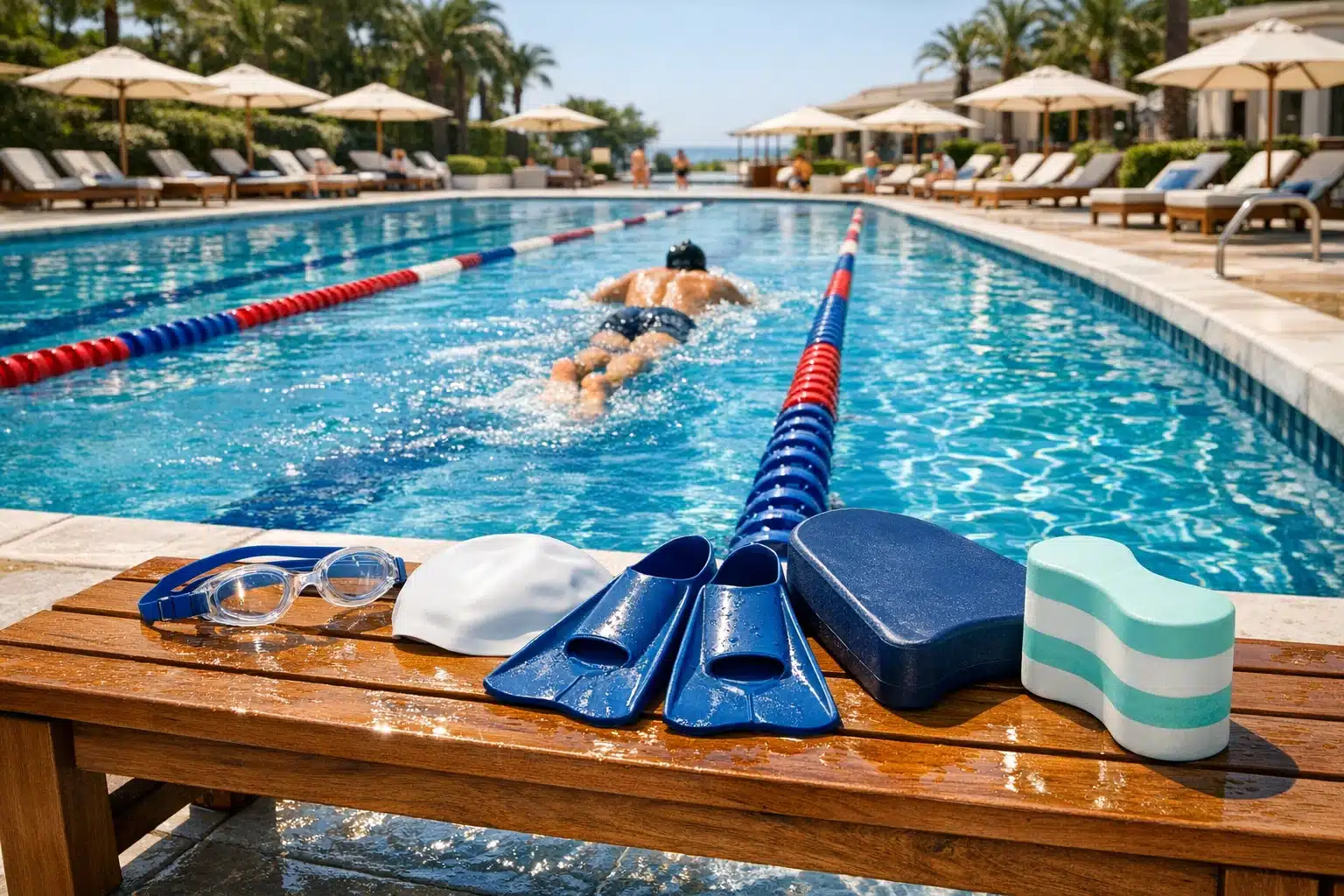
Equipment can support progress when used for a clear reason. Goggles are close to essential because seeing underwater changes confidence and alignment. A well-fitted cap reduces distraction and keeps hair out of the face. Kickboards isolate leg work, though overusing them can sometimes reinforce poor body position if the head lifts too high. Pull buoys support the hips and let swimmers concentrate on the pull, but they should not become a crutch. Fins can improve ankle mobility and help learners experience better speed and alignment, yet they also change the feel of the stroke. Paddles increase resistance and can strengthen the catch, though careless use may overload the shoulders. The principle is simple: tools should sharpen awareness, not replace technique.
Progress in swimming is famously non-linear. One week, the water feels slick and cooperative; the next, every length feels strangely stubborn. That fluctuation is normal. Improvement often arrives through small breakthroughs: a quieter kick, a smoother exhale, a better push off the wall, or a more patient catch. Because the sport is technical, effort alone does not guarantee better results. Consistency, reflection, and smart progression matter more. Swimmers who keep brief notes on how a set felt, what cue worked, and where fatigue changed form often improve faster than those who train without feedback. In that sense, the pool becomes a laboratory. Every session teaches something, provided the swimmer pays attention.
Safety, Community, and a Conclusion for Everyday Swimmers
Swimming carries joy, challenge, and practical value, but it also demands respect for safety. In pools, that means understanding lane etiquette, entering water carefully, and choosing sessions that match one’s actual ability rather than one’s ambition. In open water, the stakes increase. Temperature, visibility, currents, waves, and distance from shore all influence risk. Even strong pool swimmers can feel disoriented in a lake or sea because there are no walls, no lane ropes, and often no clear visual line below. Cold water can affect breathing and coordination very quickly, while fatigue may arrive earlier than expected when chop or current adds resistance. For these reasons, swimmers should favor lifeguarded areas when possible, use bright caps or tow floats in open water, check weather conditions, and avoid swimming alone.
Good safety habits are practical rather than dramatic.
• Learn basic floating, treading water, and safe breathing control.
• Build endurance gradually instead of jumping into long distances too soon.
• Tell someone where you are swimming, especially outdoors.
• Respect pool rules and local water advisories.
• Stop immediately if pain, dizziness, or unusual shortness of breath appears.
These habits are not barriers to enjoyment; they are what make enjoyment sustainable. Swimming is most rewarding when confidence is grounded in preparation rather than wishful thinking. Lessons remain valuable at every age, and many adults discover that formal instruction unlocks both safer behavior and better technique far more quickly than trial and error.
There is also a social side to the sport that deserves recognition. Pools are often among the few spaces where very different generations share the same activity at once. One lane may hold a teenager training for competition, another a parent relearning freestyle, another a retiree maintaining mobility. Masters groups, school teams, learn-to-swim programs, triathlon clubs, and open-water communities all show how broad the swimming world has become. This range is part of its appeal. A swimmer does not need elite goals to belong. Some people chase race times, some want relief from desk-bound routines, and some simply love the calm sound of water folding away from each stroke.
For the everyday reader, that may be the most useful conclusion of all. Swimming does not ask you to arrive as an expert. It asks you to start where you are, stay curious, and build trust in a skill that can serve you for decades. If you want exercise with less impact, a richer sense of body control, and a lifelong way to challenge yourself without monotony, the pool is a very good place to begin. Take a lesson, choose realistic sessions, learn the feel of each stroke, and let progress come length by length. In time, the water stops feeling like an obstacle and starts feeling like an ally.