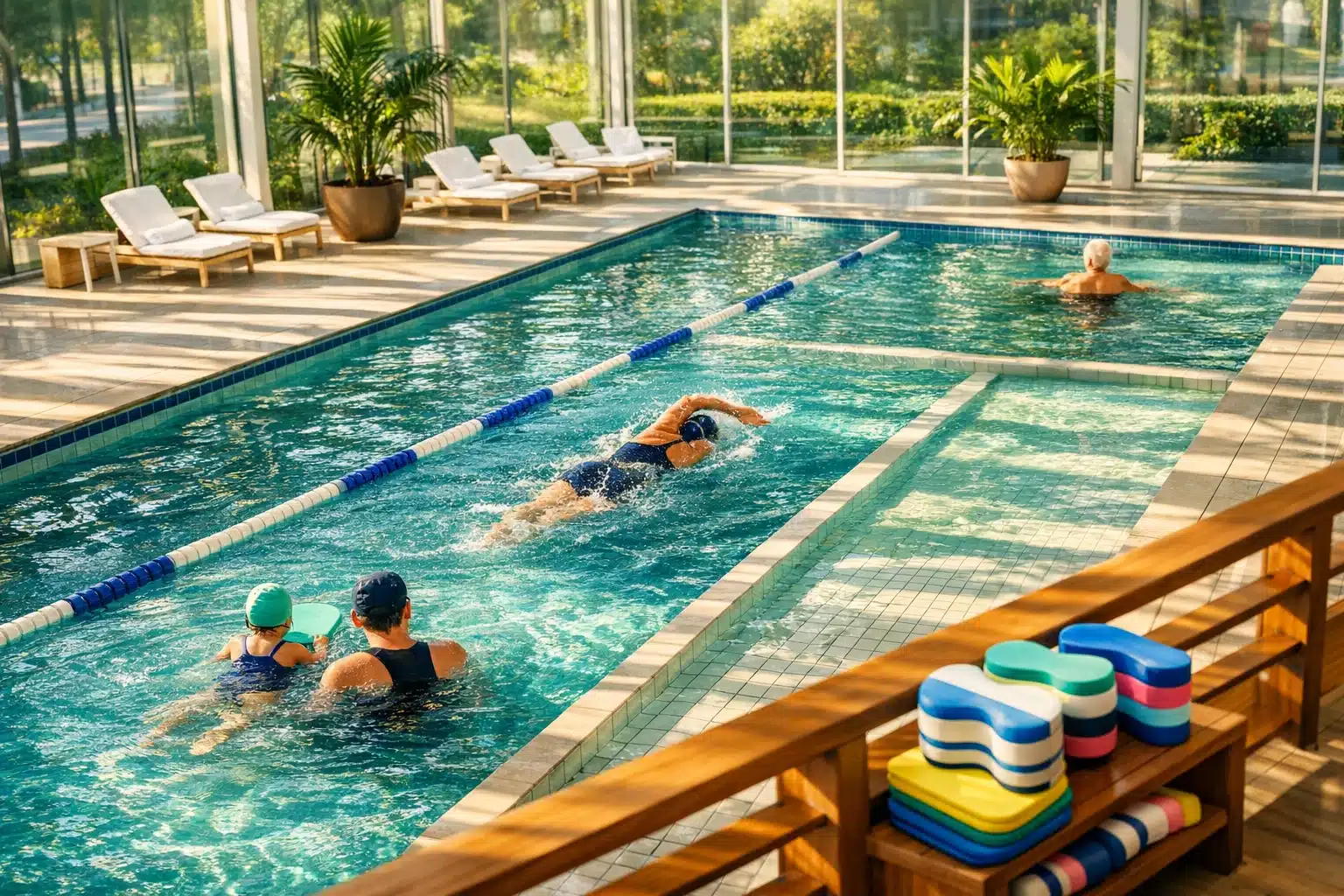
Explore the world of swimming
Swimming sits at an unusual crossroads where sport, survival skill, and quiet pleasure meet. A child splashing in a shallow lane, an athlete chasing fractions of a second, and an adult easing sore joints through warm water are all doing versions of the same thing: moving through a medium that resists every motion and rewards every improvement. That blend of challenge and accessibility keeps swimming relevant in schools, fitness programs, rehabilitation, and recreation around the world.
Outline
- Why swimming is different from most other forms of movement and exercise
- The physical and mental benefits that make swimming valuable across age groups
- A practical comparison of the main strokes and the techniques that shape efficiency
- Safety rules, training structure, and equipment choices for better sessions
- How swimming fits different goals, life stages, and long-term routines
Why Swimming Holds a Unique Place in Human Movement
Swimming is unusual because it is not simply an exercise choice; it is also a safety skill, a competitive discipline, and a lifelong leisure activity. Very few activities move so comfortably between these roles. Someone may first enter the water to learn how not to panic, later use it to recover from injury, and eventually discover a sport that rewards discipline with remarkable precision. That broad usefulness helps explain why swimming has a place in schools, community centers, rehabilitation clinics, holiday travel plans, and the Olympic Games.
Water changes the rules of movement. On land, gravity dominates almost every action, and impact travels through the joints with every stride, jump, or sudden stop. In water, buoyancy reduces weight-bearing stress, which is one reason swimming often feels kinder to knees, hips, and ankles than high-impact exercise. At the same time, the body faces constant resistance. Water is far denser than air, so even simple movements ask the muscles to work. This is the quiet trick of swimming: it can feel gentle while still demanding coordination, breath control, and endurance.
Swimming also has a fascinating split personality. It can be solitary and meditative, with only the rhythm of bubbles and breath for company, or intensely social in a team practice where every second is measured. In competition, margins are razor thin, starts and turns matter enormously, and efficiency becomes almost mathematical. In recreation, the goals can be far more relaxed: enjoy the water, improve confidence, or finish a calm half hour feeling lighter than when you arrived.
- In a pool, swimmers often focus on pace, stroke count, and repeatable technique.
- In open water, they must also read waves, temperature, currents, and visibility.
- In rehabilitation settings, movement quality and comfort may matter more than speed.
That flexibility is part of swimming’s lasting appeal. It can be measured with stopwatches and split times, yet it can also be deeply personal. One person swims to race. Another swims to think. Another simply wants to cross a body of water without fear. All of those goals are valid, and each begins with the same essential lesson: the water does not care about status, only about how well you learn to work with it rather than against it.
Health Benefits: Fitness, Recovery, and Mental Clarity
Swimming is often praised as a full-body workout, but that phrase only becomes meaningful when you look at what the body is actually doing. The arms pull, the shoulders stabilize, the core keeps the trunk aligned, the hips help rotate the body, and the legs kick to support balance and propulsion. Meanwhile, the heart and lungs work continuously to supply oxygen. That combination makes swimming a strong form of aerobic exercise, and public health guidance from organizations such as the World Health Organization supports regular moderate to vigorous activity for long-term health. Swimming can clearly contribute to those weekly activity goals.
One of its greatest advantages is low impact. People with joint discomfort, people returning to exercise after a break, and older adults often find that water allows them to move more freely than land-based routines do. Aquatic exercise is frequently included in recovery and rehabilitation programs because buoyancy reduces strain while resistance remains available. This does not mean swimming is effortless. In fact, poor technique can make it tiring very quickly. But when form improves, many swimmers discover that they can train hard without the pounding associated with some other sports.
The mental side matters just as much. Repetitive strokes, controlled breathing, and the muffled soundscape of the pool create a kind of moving focus. For some, swimming is the closest thing exercise has to pressing a reset button. Stress does not vanish the instant someone enters the lane, yet the structure of swimming naturally encourages attention. You count lengths, time breaths, notice body position, and settle into rhythm. That rhythm can be deeply calming.
- Cardiovascular support comes from sustained movement over time.
- Muscular endurance improves because resistance is present throughout the stroke.
- Mobility may benefit when swimmers move joints through controlled ranges of motion.
- Mental wellbeing can improve through routine, focus, and the simple relief of being active.
Swimming is not a miracle cure, and it should not be treated like one. It will not fix every injury or suit every personality. Some people dislike putting their face in water, struggle with access to facilities, or need coaching before the workout becomes enjoyable. Still, for a large number of people, swimming offers a rare combination of challenge and relief. It can raise the heart rate without punishing the joints, build confidence alongside fitness, and turn exercise into something that feels less like obligation and more like a conversation between body, breath, and water.
Understanding the Main Strokes and the Technique Behind Them
Swimming becomes far more rewarding when the major strokes make sense, because each stroke teaches the body a different relationship with the water. Front crawl, often called freestyle in racing, is generally the fastest and most commonly practiced stroke. Its alternating arm pull, flutter kick, and side breathing pattern make it efficient over many distances. Good freestyle relies on body position more than many beginners expect. If the hips sink or the head lifts too high, drag increases and effort rises sharply. When the body stays long and balanced, the stroke begins to feel smoother, almost like sliding forward through a narrow channel.
Backstroke uses an alternating arm action as well, but the swimmer remains face up. Many people find it friendlier for breathing because the mouth stays clear of the water, though staying straight in the lane can be tricky. It is often a useful stroke for balancing shoulder use and developing body awareness. Breaststroke looks simpler than it is. Because the head can come up regularly and the pace is often slower, new swimmers may assume it is the easiest option. In reality, timing is everything. The kick, pull, and glide must work together. Done well, breaststroke is economical and controlled; done poorly, it can feel awkward and tiring.
Butterfly is the most physically demanding of the four competitive strokes for many swimmers. It uses a simultaneous arm recovery and a wave-like body motion supported by dolphin kicks. Beautiful butterfly looks almost theatrical, but the drama comes from precision, not chaos. Even skilled swimmers respect how quickly it can expose weak timing.
- Freestyle is usually the fastest and most practical stroke for building endurance.
- Backstroke supports continuous breathing and highlights alignment issues.
- Breaststroke offers visibility and control but depends heavily on timing.
- Butterfly develops power and rhythm, though it requires strong technique.
Beyond the named strokes, several technical principles connect all effective swimming. First, streamline matters. Water rewards shapes that reduce drag. Second, breathing must fit the stroke rather than interrupt it. Many beginners treat breaths as emergencies, lifting or twisting too far and losing balance. Third, propulsion starts with holding water, not slapping at it. Good swimmers do not simply move their arms quickly; they direct pressure backward so the body can travel forward.
This is why lessons and feedback are so valuable. Two swimmers may work equally hard, yet the one with better technique usually moves farther per stroke and tires more slowly. A small correction in head position, kick timing, or hand entry can change the entire feel of a lap. The magic of swimming is that progress is often invisible to spectators but unmistakable to the swimmer. One day the water feels combative. A week later, after one useful adjustment, it feels cooperative.
Safety, Training Structure, and Gear That Actually Matters
Swimming has enormous benefits, but the water demands respect. Safety is not an optional extra added after the fun begins; it is part of the activity itself. Strong swimmers can still become exhausted, disoriented, or overconfident, especially outside the controlled setting of a pool. That is why beginner instruction, supervision, and sound judgment remain essential. In pools, lifeguards, lane rules, and known depths create a more predictable environment. In open water, variables multiply: temperature, current, weather, boat traffic, waves, and visibility can all change the experience within minutes.
For new swimmers, the safest path is also the most effective one: learn fundamentals in a supervised setting. Practice floating, breathing, treading water, and basic propulsion before chasing distance. Confidence built on skill is steady; confidence built on guesswork can disappear fast. Open-water swimmers should never treat a lake or sea like a bigger pool. Navigation is harder, sight lines are different, and cold water can affect breathing almost immediately.
- Swim where supervision is available whenever possible.
- Use a buddy system in open water rather than swimming alone.
- Check weather, water conditions, and visibility before entering.
- Build distance gradually instead of doubling volume in a single week.
- Stop if pain, dizziness, or unusual breathlessness appears.
Training structure matters because random laps often lead to random results. A simple session usually works better when it has a purpose. Many swimmers divide practice into a warm-up, a skill block, a main set, and an easy finish. That format helps the body prepare, allows technique work before fatigue climbs too high, and gives the workout a clear direction. A beginner session might include easy lengths, kick practice with a board, short repeats with rest, and a relaxed cooldown. An intermediate session might add pace control, pull work, or interval training using the pace clock.
As for gear, less is required than many people assume. A well-fitting swimsuit and reliable goggles are the true essentials. A cap can help keep hair managed and reduce drag, though it is not mandatory everywhere. Kickboards, pull buoys, fins, and paddles can be useful training tools, but they should support learning rather than replace it. Gadgets cannot compensate for poor balance or rushed breathing. Sensible gear makes swimming easier to practice; sound habits make it safer and more effective. In the end, the most valuable equipment is still knowledge: knowing your limits, knowing the conditions, and knowing when to push and when to step back.
Swimming Across Ages, Goals, and Everyday Life
One of swimming’s most impressive strengths is its ability to stay relevant throughout life. For children, it can begin as water familiarity, progress into formal lessons, and become a foundation for safety and confidence. For teenagers, it may become a school sport, a social setting, or cross-training for other activities. For adults, swimming often returns in a different form. Some come back to it after years away because they want exercise that feels sustainable. Others arrive after injury, during stressful periods, or in search of an activity that leaves them energized rather than battered.
Older adults frequently benefit from swimming and other aquatic exercise because the environment supports movement without the same level of joint impact found in some land-based routines. Adaptive swimming programs also widen access for people with disabilities, showing clearly that skill in water does not belong to one body type or one life stage. The lane does not ask where you started. It asks what you can learn, repeat, and refine today.
Goals in swimming vary widely, and that variety is healthy. Not everyone wants to race, count every split, or master butterfly. Some want to complete their first continuous 200 meters without stopping. Some want a structured workout before work. Others want to feel comfortable in the ocean on vacation, join a masters club, or simply make movement a normal part of the week again. A useful goal in swimming is specific enough to guide practice but realistic enough to sustain motivation.
- Confidence goals focus on comfort, floating, breathing, and control.
- Fitness goals emphasize consistency, endurance, and recovery.
- Performance goals may include speed, pacing, technique, and race strategy.
- Wellbeing goals often center on routine, stress relief, and enjoyment.
Swimming also carries a rare sensory quality. The world narrows to lane lines, reflections, and the small burst of sound that follows each exhale. For a busy mind, that can feel like relief. For a competitive mind, it feels like focus. For many people, it is both. The beauty of the sport is that progress does not need to be dramatic to be meaningful. A calmer breath, a smoother turn, an extra length, or a little less fear in deep water can all count as real improvement.
That is why swimming lasts. It adapts. It meets people where they are and offers more as they grow. Some sports belong mainly to youth or peak physical power. Swimming can belong to the beginner, the patient learner, the recovering athlete, the older adult, and the lifelong competitor all at once. Few activities make room for that many stories in a single pool.
Conclusion for New and Returning Swimmers
If you are curious about swimming, the most useful starting point is not speed or distance but comfort, safety, and repeatable technique. Learn the basics well, choose realistic goals, and let consistency do the heavy lifting over time. Swimming rewards patience more than bravado, and that is good news for ordinary readers who want something practical, sustainable, and genuinely engaging. Whether your aim is better fitness, greater confidence in water, or a calmer mind after a long day, swimming offers a path that can begin with one lesson and grow for years.