Explore the world of swimming
Water has a way of stripping activity down to essentials: breath, balance, rhythm, and forward motion. Swimming matters because it blends recreation, survival skill, exercise, and sport in a single practice that can adapt to childhood lessons, adult fitness goals, and elite competition alike. Whether someone wants gentler training for sore joints or the thrill of racing a clock, the pool offers a rare mix of challenge and support. The sections below trace that journey from basic appeal to lasting value.
Outline: this article begins with swimming’s broad appeal and real-world relevance, moves into physical and mental benefits, explains the main strokes and their differences, then covers learning, training, equipment, and safety. It closes with a practical conclusion for readers who want to make swimming part of everyday life.
Why Swimming Matters: A Skill, a Sport, and a Way to Move
Swimming occupies a special place in human life because it is useful in more than one sense. It can be a leisure activity, a demanding competitive sport, a rehabilitation tool, and a safety skill that may one day protect a life. Few activities carry that kind of range. A person might first enter the water through nervous beginner lessons, return years later for low-impact fitness, and eventually discover open-water events, masters competition, or family recreation. The same body of water can host a toddler’s first kick, an older adult’s joint-friendly workout, and a serious athlete’s interval set.
Its relevance is also global. Swimming has ancient roots in human survival and travel, but modern swimming reaches far beyond necessity. It is part of school programs, military training, physical therapy, Olympic competition, and community recreation. In many countries, access to lessons is considered a public safety issue because drowning remains a significant cause of accidental death, especially among children. That fact gives swimming a practical value that team sports do not always share. Learning to dribble a ball can be fun; learning to float and breathe calmly in water can be critical.
What draws people in, though, is not only utility. Water changes the experience of movement. Buoyancy reduces impact, resistance surrounds the body from every direction, and sound softens into a muffled hush. For some, the pool feels like a laboratory of technique. For others, it feels more like a moving meditation. Unlike many land-based activities, swimming rewards patience as much as power. A tense body sinks into struggle; a coordinated body seems to slip forward almost quietly.
Compared with sports that depend on expensive facilities, opponents, or specialized physical traits, swimming offers several entry points:
- Recreational swimming for enjoyment and general activity
- Lap swimming for endurance and fitness
- Technique-based training for skill improvement
- Competitive swimming for speed and strategy
- Therapeutic or recovery-focused sessions for mobility
That versatility helps explain why swimming remains relevant across generations. It can be social or solitary, structured or playful, intense or gentle. In a world that often divides exercise into narrow categories, swimming quietly refuses to stay in one lane.
How Swimming Benefits the Body and Mind
Swimming is often praised as a full-body workout, and that description is accurate without being a cliché. Water is roughly 800 times denser than air, so every stroke asks the body to push against meaningful resistance. Arms pull, legs kick, the core stabilizes, and the lungs work in rhythm with movement. Because that resistance comes from the surrounding water rather than external weights, the effort can feel smooth even when it is demanding. A moderate session may leave a swimmer pleasantly tired, while a hard interval set can be as challenging as many land-based workouts.
From a health perspective, swimming supports cardiovascular fitness, muscular endurance, and mobility. Public health guidelines commonly recommend at least 150 minutes of moderate aerobic activity per week for adults, and swimming can contribute directly to that target. Depending on body size, stroke choice, and pace, an hour of swimming can use several hundred calories, with vigorous lap swimming often landing in a range comparable to steady cycling or jogging. It also trains breathing control in a way few other exercises do. Instead of breathing whenever the body feels like it, swimmers learn to coordinate inhalation and exhalation with timing and posture.
One major advantage is reduced impact. Buoyancy lowers the load on joints, which can make swimming appealing for older adults, people returning from injury, or those carrying extra body weight. In chest-deep water, the body bears far less weight than it does on land, so movement may feel easier and less jarring. That does not mean swimming is effortless; it means the stress profile is different. For someone whose knees dislike running, the pool can feel like a door reopening.
Mental benefits matter too. The repeated cycle of stroke, breath, and turn can settle an overactive mind. Some swimmers describe a good session as clearing static from the brain. Research on physical activity more broadly links regular exercise with improved mood, lower stress, and better sleep, and swimming fits well within that picture.
Its advantages become clearer in comparison:
- Compared with running, swimming usually creates less impact on hips, knees, and ankles.
- Compared with cycling, it engages the upper body more directly.
- Compared with gym circuits, it often feels cooler and less repetitive.
- Compared with walking, it can challenge heart and lungs more intensely at higher speeds.
Swimming is not automatically the perfect choice for everyone, but it offers a rare combination of conditioning, coordination, and recovery-friendly movement. That balance is a big reason it remains a favorite for beginners and serious athletes alike.
Understanding the Main Strokes and the Technique Behind Them
To an inexperienced eye, swimming can look simple: get in, move arms, kick, repeat. In practice, technique shapes almost everything. Small changes in head position, body line, timing, or hand entry can turn wasted effort into smooth propulsion. That is one reason swimming is so humbling and so satisfying. Improvement often comes not only from getting stronger, but from learning how to stop fighting the water.
The four main competitive strokes are freestyle, backstroke, breaststroke, and butterfly. Freestyle, usually swum as front crawl, is the fastest and most commonly taught for fitness. It relies on a long body position, alternating arm recovery, and a flutter kick. Efficient freestyle feels like sliding downhill through a moving surface. Backstroke mirrors some of the same rhythm, but on the back, with the face above water. Many beginners enjoy it because breathing is less stressful, though staying straight in the lane takes practice.
Breaststroke is different in both timing and feel. Its pull and kick happen in a more symmetrical pattern, with a glide phase between efforts. It is often slower than freestyle, but its rhythm can feel intuitive to new swimmers. Butterfly is the most dramatic and usually the most technically demanding. Both arms recover together, the body undulates, and the kick typically follows a dolphin pattern. When done well, butterfly looks almost theatrical; when done poorly, it feels like wrestling a wave with your shoulders.
Each stroke emphasizes different strengths:
- Freestyle rewards efficiency, endurance, and streamlined rotation.
- Backstroke develops posture awareness, shoulder control, and steady rhythm.
- Breaststroke highlights timing, flexibility, and patient coordination.
- Butterfly demands power, timing, body control, and disciplined breathing.
Technique extends beyond the stroke itself. Starts, turns, and underwater phases matter enormously in racing, and even recreational swimmers benefit from learning basics like pushing off in streamline or exhaling continuously underwater. Drills are especially useful because they isolate one part of the movement. A kickboard can help focus on leg action; one-arm freestyle can expose balance issues; sculling can teach how the hands feel pressure in the water.
For readers deciding where to begin, the answer depends on purpose. Freestyle usually serves fitness best because it is efficient and widely usable. Backstroke offers variation and can reduce neck strain from constant face-down work. Breaststroke suits swimmers who prefer a calmer pace, while butterfly is often a later goal rather than a starting point. Learning the strokes is less like memorizing steps and more like tuning an instrument. The body becomes the instrument, and the water gives immediate feedback.
Learning to Swim, Training Well, and Staying Safe
Swimming rewards structured learning. A beginner who tries to power through the water without fundamentals often becomes exhausted quickly and assumes the sport is simply too hard. In reality, early progress usually depends on comfort, not force. Floating, exhaling underwater, holding a streamlined shape, and learning to relax the neck and shoulders matter before speed ever enters the conversation. Confidence begins when the swimmer stops treating water as an enemy and starts reading it as a surface that supports as well as resists.
A sensible learning pathway usually moves through a few stages. First comes water comfort: submerging the face, blowing bubbles, floating on front and back, and pushing off the wall. Then comes propulsion: kick patterns, arm actions, and breathing coordination. Only after those pieces begin to connect does endurance work make sense. Formal lessons can make this process smoother, and studies have linked swimming instruction with lower drowning risk among children. That does not make lessons a magic shield, but it does underline how valuable competent teaching can be.
For fitness-oriented adults, training should have a purpose beyond endless laps. A balanced session may include:
- A warm-up to loosen shoulders, hips, and breathing rhythm
- Drills to sharpen one technical point
- Main sets for endurance, speed, or pacing
- Recovery swimming to bring heart rate down gradually
Equipment can help, though none of it replaces technique. Goggles improve vision and reduce hesitation. A cap can keep hair manageable and lower drag slightly. Kickboards, pull buoys, fins, and paddles all have training uses, but each tool should match a clear goal. Fins, for example, can help beginners feel body position and improve ankle movement, while paddles can build strength and reveal flaws in the pull if used carefully.
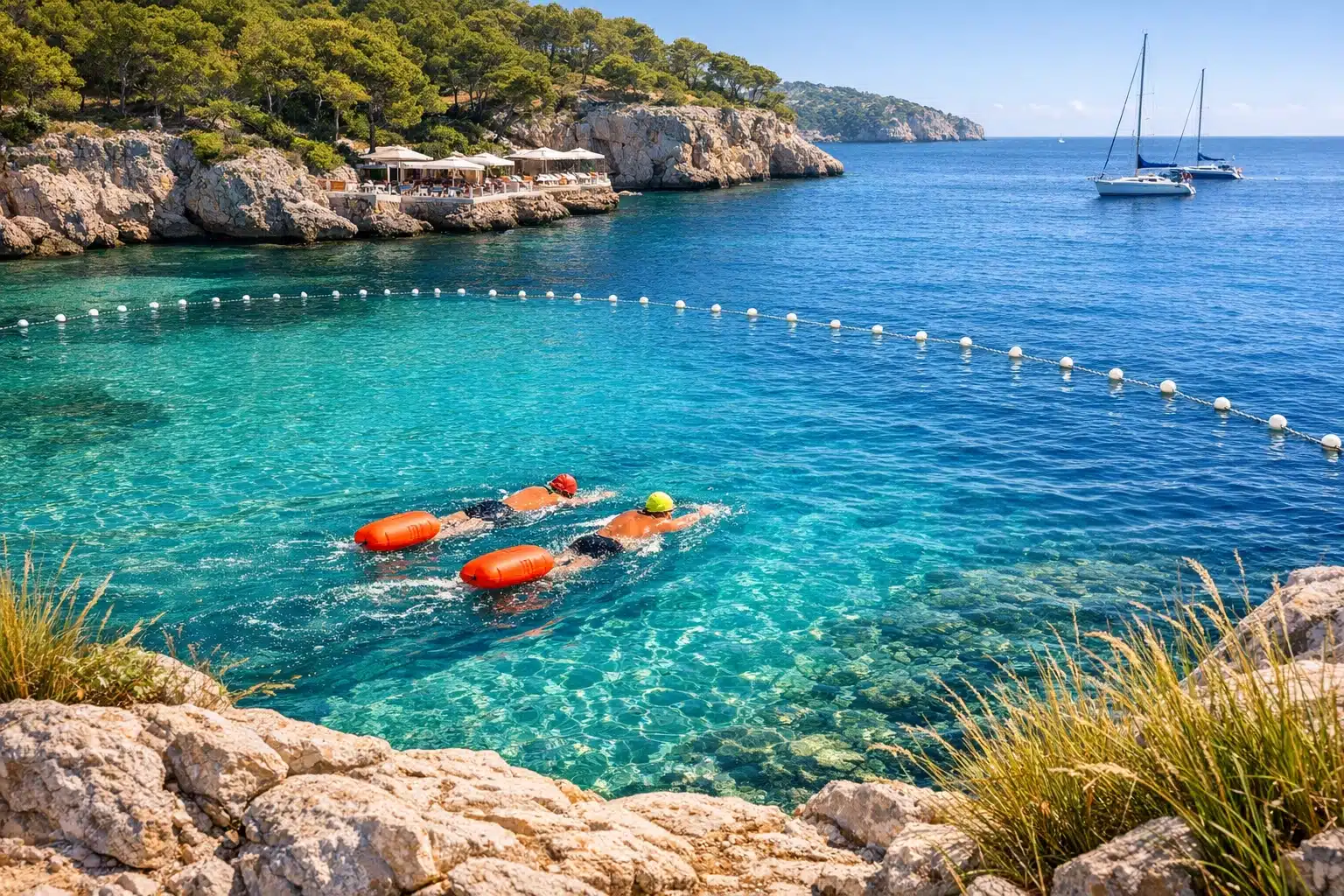
Safety deserves equal attention. Pool swimmers should learn lane etiquette, avoid diving into unknown depths, and respect lifeguard instructions. Open-water swimmers face a different set of variables: currents, low visibility, cold shock, changing weather, and boat traffic. A bright cap, tow float, buddy system, and local knowledge are basic precautions, not optional extras. Even skilled pool swimmers can feel suddenly novice-like in a lake or sea, where the black line is gone and the water moves back.
The smartest approach is steady rather than heroic. Two or three thoughtful sessions a week often produce better progress than rare all-out efforts. Swimming favors consistency, and the body learns confidence stroke by stroke.
Conclusion: Making Swimming Part of Your Life
If you are curious about swimming, the good news is that it does not demand one fixed identity from you. You do not have to become a racer, buy elite gear, or chase perfect technique on day one. You can begin as a cautious beginner, a parent looking for a valuable skill for a child, an adult searching for joint-friendly exercise, or an athlete who wants a smarter form of cross-training. Swimming meets each of those readers differently, yet it offers all of them something useful: better body awareness, stronger aerobic capacity, practical safety knowledge, and a rare sense of motion that feels both demanding and calm.
What makes swimming especially worthwhile over a lifetime is its adaptability. A teenager may love sprint sets and competition. A busy professional may use early-morning laps to think before the day gets noisy. An older adult may find comfort in water-supported movement when impact-heavy exercise becomes less appealing. Para swimming, masters programs, aqua fitness classes, and open-water communities also show that the sport is broader than the narrow image of lane ropes and stopwatches. There is room for ambition, but there is also room for simple enjoyment.
The most practical way forward is to start with a clear purpose. If safety is the priority, focus first on floating, breathing control, and supervised lessons. If fitness is the goal, choose a manageable weekly routine and learn one stroke well enough to sustain it. If motivation is the challenge, join a class or a local group, because routine becomes easier when other people are expecting to see you on deck.
In the end, swimming is compelling because it teaches more than movement. It teaches patience, timing, and respect for an environment that does not bend to impatience. The water gives honest feedback every single time. For readers who want exercise with variety, skill with purpose, and challenge without constant impact, swimming is not merely an option worth considering. It is one of the most practical and rewarding habits you can build.