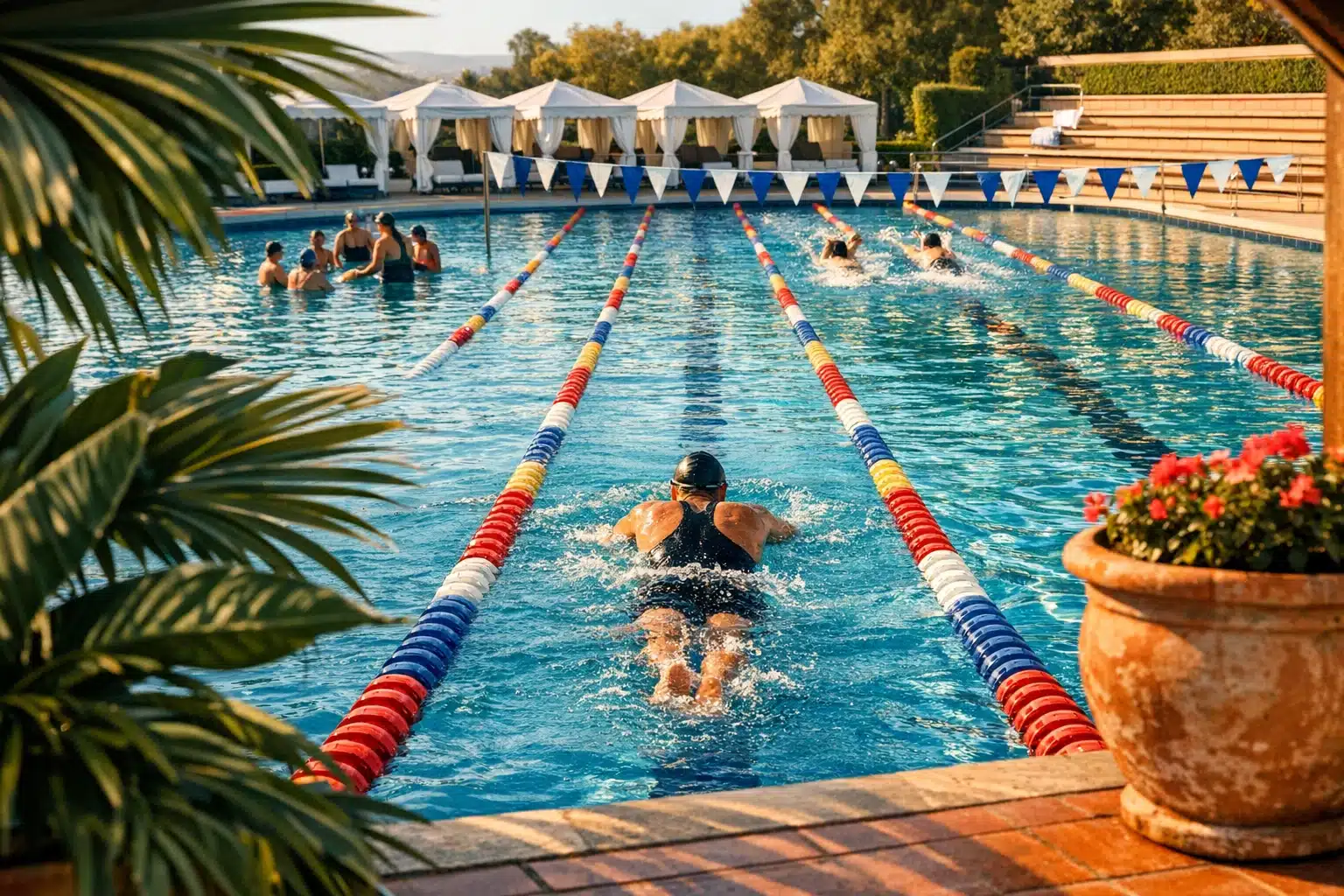
Explore the world of swimming
Swimming is one of those rare activities that can feel playful, meditative, and physically demanding at the same time. It matters because it serves many purposes at once: a life-saving skill, a competitive sport, a practical form of exercise, and for many people, a way to clear the mind after a long day. Whether you are curious about your first lesson or hoping to refine your stroke, understanding how swimming works makes every lap more rewarding.
This article unfolds in five parts. First, it maps the broader meaning of swimming and its place in sport and daily life. Next, it explores health and fitness benefits, then moves into technique and stroke basics. After that, it looks at safety and equipment, before ending with realistic ways to make swimming part of a long-term routine.
- The role of swimming in history, sport, and recreation
- Physical and mental benefits of time in the water
- How the main strokes work and what beginners should learn first
- Essential safety habits, gear, and pool versus open-water differences
- How to build a sustainable swimming practice for fitness, fun, or competition
Swimming in Context: More Than a Sport
Swimming has been part of human life for thousands of years, long before it became an organized sport. Ancient artwork from several civilizations includes scenes of people moving through water, which suggests that swimming began as a practical survival skill and gradually evolved into something broader. Today it sits in a fascinating middle ground. It can be a lesson a child takes for safety, a low-impact workout for an older adult, a demanding event in the Olympic Games, or simply a peaceful hour at the local pool before work. Few activities stretch across so many ages, goals, and lifestyles with the same ease.
Modern competitive swimming has a clear place in international sport. Men’s swimming appeared in the first modern Olympic Games in 1896, and women’s swimming joined the Olympic program in 1912. Since then, the sport has expanded into pool racing, artistic swimming, water polo, diving, and open-water events. Yet the competitive side is only part of the story. Recreational swimming remains the entry point for most people, and that matters. A lane line and a stopwatch may define one version of the sport, but a summer lesson, a community pool session, or a careful open-water dip can be just as meaningful.
Swimming is also unusual because the environment changes the experience. On land, gravity dominates every movement. In water, buoyancy changes the rules. The body feels lighter, joints absorb less impact, and resistance comes from every direction. Water is far denser than air, so even small movements require control and effort. That is why two swimmers can cover the same distance and have completely different experiences depending on their technique. One glides efficiently, almost like a letter being slid across a polished desk. Another fights the water and tires quickly. The contrast is not magic. It is physics, practice, and body awareness working together.
Its broad relevance also extends beyond fitness. Swimming literacy is a public safety issue. According to the World Health Organization, drowning causes hundreds of thousands of deaths globally each year, making water competence far more than a leisure topic. Learning to float, breathe calmly, and move efficiently in water can increase confidence and reduce risk. For families, athletes, and casual exercisers alike, swimming matters because it blends enjoyment with usefulness. It offers challenge without demanding a single body type, and it rewards patience in a way that feels both ancient and modern.
Why Swimming Is Good for the Body and Mind
One reason swimming remains so popular is that it offers a rare combination of cardiovascular training, muscular work, and joint-friendly movement. Unlike running, which places repeated impact on the knees, hips, and ankles, swimming allows people to exercise while supported by water. That makes it appealing for many older adults, people returning from some injuries, and anyone looking for variety in a training plan. At the same time, it should not be mistaken for an easy option. A steady swim can raise heart rate, challenge breathing rhythm, and engage multiple muscle groups at once.
Physically, swimming works the shoulders, back, chest, core, glutes, and legs, though the emphasis changes from stroke to stroke. Freestyle often feels smooth and rhythmic, backstroke encourages alignment and shoulder control, breaststroke relies heavily on timing, and butterfly demands strength and precision. Because water pushes back on every kick and pull, the body is constantly managing resistance. That resistance is one reason swimming can be effective for building muscular endurance. Energy use varies with intensity, body size, and stroke, but many adults burn roughly 200 to 400 calories during 30 minutes of lap swimming, with harder efforts climbing higher. The exact number matters less than the larger point: swimming can scale from gentle movement to very demanding training.
The mental benefits are just as interesting. Many swimmers describe a session as calming, not because it is effortless, but because it narrows attention. You notice the sound of exhalation underwater, the pattern of bubbles, the count of strokes, the black line at the bottom of the pool. That rhythm can quiet mental clutter. Research on exercise in general consistently links regular physical activity with improved mood, lower stress, and better sleep, and swimming fits well within that picture. For some people, it becomes moving meditation with a kickboard nearby.
Several practical benefits stand out:
- It can improve cardiovascular fitness without repeated impact on joints.
- It trains coordination because breathing, kicking, and arm movement must work together.
- It is adaptable for different ages and fitness levels.
- It can complement land-based sports by supporting recovery and aerobic conditioning.
There are limits, of course. Not everyone finds swimming comfortable at first, and some people need gradual exposure to water, coaching, or medical guidance before starting a new exercise routine. Still, compared with many forms of training, swimming offers unusual flexibility. It can be gentle enough for rehabilitation settings and demanding enough for elite competition. That range is part of its quiet appeal: the same pool can hold a beginner learning to float, a triathlete chasing pace, and a grandparent enjoying steady laps for health.
Learning the Strokes: Technique, Breathing, and Efficiency
Swimming rewards technique more visibly than many other activities. In running, poor form may still carry you forward for quite a while. In swimming, inefficient movement becomes obvious almost immediately because the water gives constant feedback. If the head lifts too high, the hips tend to sink. If the kick is frantic, energy disappears without much forward travel. If breathing is mistimed, the whole stroke can unravel within a few lengths. This is why beginners often improve dramatically not by getting stronger first, but by becoming more organized in the water.
Freestyle, also called front crawl, is usually the first stroke taught for fitness because it is efficient and widely used. The main ideas are simple to state and surprisingly hard to master: keep the body long, rotate through the torso, reach forward without overextending, and exhale steadily into the water before turning the head to breathe. Backstroke shares some of freestyle’s body rotation but places the swimmer face-up, which removes breathing pressure while adding a new challenge: swimming straight without looking where you are going. Breaststroke uses a glide-and-recover rhythm and can feel intuitive for beginners, though strong breaststroke technique is highly technical. Butterfly is the most demanding of the four competitive strokes, asking for timing, coordination, and a strong undulating rhythm.
For a new swimmer, the best progression is often skill-based rather than distance-based. Before chasing laps, it helps to develop a few foundations:
- Comfort putting the face in the water and exhaling calmly
- A balanced body position with the hips near the surface
- A relaxed flutter kick that starts from the hips rather than the knees alone
- Basic arm recovery and entry without crossing over the center line
- Breathing that fits the stroke instead of interrupting it
Drills can make these pieces easier to learn. Kickboard work isolates the legs, side-kicking teaches balance, and single-arm drills help swimmers notice rotation and catch position. Pull buoys can be useful for isolating the upper body, although relying on them too early may hide balance problems. A good coach often looks for quiet corrections rather than dramatic ones: soften the hands, lengthen the neck, press the chest slightly, finish the stroke, slow the kick. Tiny changes can free up remarkable efficiency.
Comparisons between swimmers often come down to how they move through the water rather than how hard they try. A novice may splash and strain over 25 meters, while an experienced swimmer appears smooth with less visible effort. That difference does not mean elite swimmers are working less. It means they waste less. Technique turns effort into travel. For readers thinking about lessons, this is encouraging news. Progress is not reserved for the naturally strong. It often belongs to the patient learner who practices basics, accepts feedback, and understands that good swimming is built one controlled breath at a time.
Safety, Equipment, and the Difference Between Pool and Open Water
Swimming becomes much more enjoyable when safety is treated as part of the skill rather than as an afterthought. Confidence in water should never be confused with carelessness. Even experienced swimmers can misjudge fatigue, temperature, currents, or depth. For beginners, the safest starting point is a supervised pool with clear lane space, shallow-water access, and ideally a qualified instructor or lifeguard nearby. Learning how to float, tread water, and recover calmly after swallowing water can be just as important as learning a formal stroke.
Pool swimming and open-water swimming may look like cousins, but they behave more like different branches of the same family. Pools are controlled environments. The distance is measured, visibility is better, temperature is usually stable, and the edge is never far away. Open water introduces variables that can change from minute to minute: wind, waves, cold shock, limited visibility, weeds, currents, boat traffic, and navigation problems. A strong pool swimmer is not automatically ready for a lake or the sea. Open water requires extra preparation, local knowledge, and respect for conditions.
Essential safety habits include the following:
- Never swim alone in unfamiliar open water.
- Check weather, water temperature, currents, and local notices before entering.
- Use bright swim caps or tow floats in open water for visibility.
- Rest when technique falls apart, because poor form often signals fatigue.
- Teach children layered water safety, including supervision, barriers, and swim skills.
Equipment can make swimming safer and more comfortable, though it does not replace skill. A well-fitted swimsuit reduces drag and distraction. Goggles protect the eyes and help with orientation. Swim caps can improve comfort and visibility. Training tools such as kickboards, pull buoys, paddles, and fins each serve specific purposes, but they should be used thoughtfully. Paddles, for example, can improve feel for the water, yet poor use may overload the shoulders. Fins can help body position and ankle flexibility, but they can also mask weaknesses in the kick if used constantly.
There is also a social side to safety in shared spaces. Lane etiquette matters. Circle swimming in a crowded pool, choosing a lane that suits your speed, resting at the wall without blocking turns, and signaling before passing all make the environment safer and more pleasant. In open water, swimming with a group, using agreed landmarks, and setting clear turnaround points can reduce confusion. The water can feel inviting, even serene, but it is never entirely neutral. Respecting that fact does not reduce the joy of swimming. If anything, it preserves it.
A Practical Takeaway for New and Returning Swimmers
For most readers, the real question is not whether swimming is valuable. It is how to fit it into an actual life. The answer depends on your goal. A beginner may need short, confidence-building sessions focused on breathing and comfort. A recreational fitness swimmer may benefit from two or three sessions a week with simple structure. A triathlete may use swimming to balance cycling and running. An older adult may value the reduced impact and steady aerobic work. Swimming is flexible enough to serve all of these purposes, but progress usually comes faster when the reason for showing up is clear.
A practical routine does not need to look glamorous. It can be as modest as 30 minutes twice a week. One session might focus on technique drills and relaxed lengths. Another might build endurance through short repeats with rest. Over time, small structure helps. Many swimmers organize workouts around a warm-up, a main set, and a cool-down. That format gives purpose without making the pool feel like a spreadsheet. If motivation dips, variety helps: change strokes, alternate equipment days, try a local masters group, or set a realistic target such as swimming continuously for 500 meters with good form.
Useful long-term habits include:
- Start below your maximum effort so technique stays intact.
- Track consistency before chasing speed.
- Use lessons or occasional coaching to correct errors early.
- Mix skill work with easy aerobic swimming.
- Respect recovery, especially if you also train in other sports.
There is also room for enjoyment that is not measurable. Some people love the discipline of intervals and split times. Others love the feeling of slipping into cool water on a hot afternoon, the brief silence between strokes, and the peculiar satisfaction of finishing a set you once thought impossible. Both experiences count. Swimming can be technical without becoming rigid, and serious without becoming severe.
For new swimmers, the best takeaway is simple: begin with safety and patience, then let skill grow through repetition. For returning swimmers, trust that efficiency often comes back sooner than speed. For fitness-minded readers, treat the pool as a complement to your broader health, not a punishment. And for anyone still hesitating at the edge, remember that swimming offers something rare: a way to build strength, endurance, and confidence while learning a skill that may one day matter far beyond exercise. That is a strong reason to keep reading, keep practicing, and eventually, keep moving forward through the water with a little more ease than before.