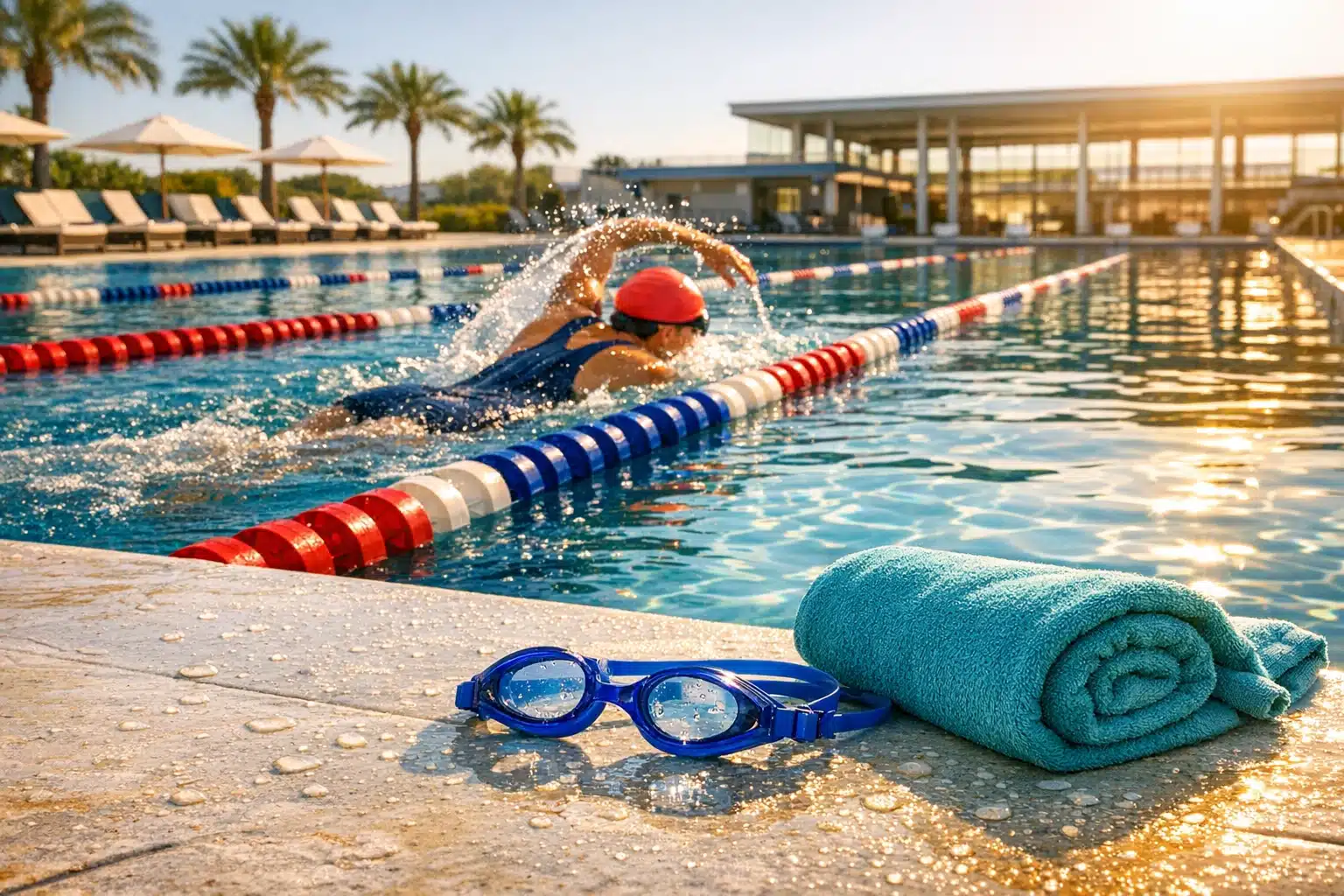
Explore the world of swimming
Explore the world of swimming
Swimming is one of those rare activities that feels playful and serious at the same time. It can improve fitness, build lifesaving confidence, and offer a low-impact workout that suits children, adults, and older learners alike. From Olympic lanes to quiet lakes, it connects sport, health, and recreation in one adaptable skill. This article explores how swimming works, why it matters, and what makes it rewarding over a lifetime.
Article Outline
- How water changes movement, breathing, balance, and effort compared with land-based exercise.
- The physical and mental benefits of swimming for different ages, goals, and fitness levels.
- The basics of learning strokes, improving technique, and building endurance with steady progress.
- Safety rules, essential gear, and the differences between pools, lakes, rivers, and the sea.
- Why swimming remains relevant as a sport, a life skill, and a sustainable routine for everyday people.
Why Water Changes the Way the Body Works
Swimming is not simply running with splashes. Water changes almost everything about movement. On land, gravity is the dominant force most people notice first. In water, buoyancy steps in and partially supports body weight, which reduces stress on joints while creating a new challenge: staying balanced, streamlined, and efficient. This is one reason swimming feels gentle on knees and hips yet surprisingly demanding after only a few laps. A body that feels light in the pool is still working hard beneath the surface.
One of the most important differences is resistance. Water is far denser than air, so every motion meets opposition. That means a swimmer trains the body in two directions at once: moving forward and controlling drag. A runner mainly thinks about propulsion, while a swimmer must also think about how not to slow down. A dropped elbow, a lifted head, or a kick that splays wide can act like a brake. In water, clumsy movement is expensive and elegant movement is efficient. This is why technique matters so much more in swimming than many beginners expect.
Breathing also becomes a deliberate skill instead of an automatic background function. During freestyle, for example, the swimmer cannot inhale whenever convenient. Air must be taken quickly, often to one side, while the body keeps rotating and the stroke keeps flowing. That rhythm creates a unique partnership between lungs, muscles, and timing. For many learners, this is the real turning point. Once breathing becomes controlled rather than hurried, swimming stops feeling like a struggle and starts feeling like travel.
Water pressure adds another layer. Hydrostatic pressure, the force water exerts on the body, can assist circulation and create a distinct physical sensation that many swimmers describe as calming and enveloping. At the same time, the horizontal position of swimming shifts effort away from impact and toward coordination. Unlike cycling, where the body is supported by a machine, or running, where impact is constant, swimming demands whole-body integration. Arms pull, legs stabilize, the core holds alignment, and the mind tracks tempo, direction, and breath.
The result is a sport and life skill that rewards patience. Progress does not always come from pushing harder. Often it comes from moving smarter, smoother, and with less wasted energy. That may sound simple, but it is exactly what makes swimming so fascinating: the water gives instant feedback, and every lap becomes a quiet conversation between physics and technique.
Health Benefits Beyond the Lap Counter
Swimming is often praised as a full-body workout, and that description is accurate without being complete. Its value goes well beyond burning calories or counting lengths. Regular swimming supports cardiovascular fitness, muscular endurance, mobility, and recovery, while offering an exercise option that many people can continue even when high-impact training becomes uncomfortable. For adults trying to meet common public health guidance, such as the recommendation of at least 150 minutes of moderate aerobic activity per week, swimming can be an effective and enjoyable way to reach that goal.
The cardiovascular benefits are significant. Sustained swimming challenges the heart and lungs, especially when a swimmer learns to hold steady pacing across several laps. Because breathing is controlled rather than constant, the respiratory system is trained in a distinctive way. Many swimmers notice improved stamina not only in the pool but in everyday life, from climbing stairs to recovering faster after exertion. Muscularly, swimming recruits the shoulders, back, chest, core, glutes, and legs in coordinated patterns. Different strokes shift the emphasis. Freestyle often feels rhythmic and efficient, breaststroke spreads effort across the chest and inner legs, backstroke promotes posture awareness, and butterfly demands powerful timing from nearly the whole body.
Swimming is also valuable because it is low impact. People recovering from certain injuries, managing joint discomfort, or easing into exercise after long inactivity may find water more forgiving than pavement or weight machines. That does not mean it is effortless. It means the challenge can be scaled with less pounding on the body. Older adults often benefit from this combination of resistance and support, especially when swimming is paired with mobility work and appropriate coaching.
Its mental effects deserve equal attention. A pool can be noisy at deck level, yet strangely peaceful once the face slips underwater. The repetition of strokes, the sound of exhaled bubbles, and the measurable structure of laps can create a calming routine. Many swimmers report that sessions reduce stress, improve mood, and help them focus. In that sense, swimming can function as exercise and reset button in the same hour.
- It supports heart and lung health through sustained aerobic effort.
- It develops muscular endurance with resistance from every direction.
- It reduces joint stress compared with many land-based activities.
- It can improve confidence, mood, and consistency with exercise.
For people who dislike repetitive gym routines, this range matters. Swimming can feel like training, therapy, recreation, and meditation depending on the day. That versatility is one of the clearest reasons it continues to attract such a wide audience.
Learning Strokes, Breathing, and Endurance
Learning to swim well is usually less about bravery than about sequence. Many beginners assume they should immediately master full strokes, but solid swimming is built from simpler pieces: comfort in the water, floating, exhaling underwater, body position, kicking, and then coordinated pulling and breathing. When those foundations are rushed, people often develop habits that make swimming harder than it needs to be. When they are learned in order, progress tends to be smoother and far less frustrating.
The first skill is confidence in the water. This includes putting the face in, opening the eyes if goggles are available, blowing bubbles, and discovering how the body floats when tension eases. A relaxed body usually rides the water better than a rigid one. Next comes alignment. Instructors often talk about a “streamline” position because a long, straight body reduces drag. The principle is simple: the more the swimmer slices through the water, the less energy is wasted fighting it.
From there, the main strokes can be compared in useful ways. Freestyle is usually the first focus because it is the fastest common stroke and often the most efficient for distance once technique settles. Backstroke can feel friendlier for breathing since the face stays out of the water, yet it introduces orientation challenges because the swimmer cannot easily see where they are going. Breaststroke is slower but popular with recreational swimmers because the stroke pattern allows easier sighting and a more controlled pace. Butterfly is the most technically demanding of the four competitive strokes, combining timing, flexibility, and power in a way that can humble even strong athletes.
Breathing deserves special respect. Many new swimmers try to lift the head forward for air, which sinks the hips and increases drag. A better approach in freestyle is rotating the body and turning the head just enough to inhale to the side. Exhaling underwater matters too. If swimmers hold their breath too long, every inhalation feels rushed. Good breathing is not dramatic; it is rhythmic.
- Start with short repeats rather than nonstop laps.
- Practice drills that isolate one skill at a time.
- Focus on form before speed.
- Use rest intervals to maintain quality movement.
Endurance grows best when technique and conditioning develop together. Ten smooth lengths can teach more than fifty frantic ones. For children, patient instruction and playful drills often work best. For adults, especially those returning after years away, short structured sessions can rebuild confidence quickly. The beautiful part is that progress is easy to notice. A calmer breath, a longer glide, or a turn completed without stopping can feel like a small victory, and in swimming, small victories accumulate into real skill.
Safety, Gear, and Different Places to Swim
Swimming is rewarding, but the water does not forgive carelessness. Safety is not an optional extra added after technique; it is part of the activity itself. A strong swimmer in a pool may still be vulnerable in cold open water, while a confident beachgoer may tire quickly in a lane session. Knowing the environment matters just as much as knowing the stroke. Pools, lakes, rivers, and oceans each ask different questions, and wise swimmers answer them before entering.
Pools are the most controlled setting. Depth is marked, visibility is usually good, and lifeguards are often present. That makes pools ideal for learning, structured training, and rehabilitation. Even so, rules matter. Slippery decks, diving in shallow water, breath-holding games, and overestimating ability can all create risk. Open water introduces a broader set of variables: currents, waves, low visibility, changing temperatures, boat traffic, underwater hazards, and the psychological effect of distance from the shore or wall. A lake can look calm and still feel unnerving once the bottom disappears. The sea can look inviting from the beach and become exhausting when wind and tide shift. Rivers can be deceptively strong even for experienced athletes.
Basic gear helps, but it does not replace judgment. Goggles improve visibility and comfort. Swim caps reduce drag and help keep hair managed, while brightly colored caps improve visibility in open water. Kickboards, pull buoys, and fins can be useful training aids when used with purpose. For open water, a tow float can increase visibility and provide a spot to rest if needed. Well-fitted swimwear matters more than fashion because loose or restrictive clothing can interfere with movement.
- Never swim alone in open water if avoidable.
- Check weather, water temperature, and local conditions before entering.
- Respect lifeguard instructions and posted safety flags.
- Stay within your actual ability, not your hoped-for ability.
- Supervise children closely, even in shallow water.
There is also a social side to safety. Swimming with a club, instructor, or trusted partner improves accountability and learning. For beginners, formal lessons are often the quickest route to safer habits. For families, clear rules around pool access, flotation devices, and supervision are essential. For fitness swimmers, warm-ups and recovery reduce cramping and overuse issues. For open-water enthusiasts, acclimatization to colder temperatures and sighting practice can prevent panic.
The best swimmers are not the reckless ones who charge in first. They are the people who understand that confidence in water is built on preparation. That mindset keeps swimming enjoyable, sustainable, and much safer over the long term.
Conclusion: Who Swimming Serves Best and How to Begin
Swimming earns its reputation because it fits so many real lives. It can be a child’s first independent physical skill, a teenager’s competitive sport, an adult’s return to exercise, an athlete’s cross-training tool, or an older person’s reliable form of movement when impact becomes less welcome. Few activities travel across age groups this smoothly. That broad usefulness is not accidental. Water offers resistance for strength, support for joints, structure for training, and enough variety to keep boredom from taking over.
If you are a beginner, the main message is simple: do not measure yourself against polished swimmers gliding through perfect laps. Start with comfort, breath control, and short sessions. If you are a parent, think of swimming as both recreation and safety education. If you are training for fitness, treat technique as part of conditioning rather than a separate concern. If you are older or returning after injury, water can provide a practical way to rebuild trust in movement without the jarring impact of many land-based workouts. In each case, the path is different, but the destination is similar: better capability, steadier confidence, and a stronger relationship with your own body.
Swimming also offers something that is harder to measure but easy to recognize once you feel it. There is a unique satisfaction in moving through water with less struggle than before. The first unbroken lap, the first calm breath during freestyle, the first open-water swim that feels controlled rather than intimidating, these moments stay with people. They are technical milestones, yes, but they are also personal ones.
- Choose lessons if you need structure and feedback.
- Choose lap swimming if you want a repeatable fitness routine.
- Choose open water only after building skill and safety awareness.
- Choose consistency over intensity when creating a long-term habit.
For most readers, that is the most useful conclusion of all. You do not need elite goals to benefit from swimming. You need access, patience, and a willingness to learn one layer at a time. Whether your aim is health, confidence, fun, or performance, swimming offers a rare combination of practicality and pleasure, and that is why it remains worth exploring.