Explore the world of swimming
Swimming sits at the crossroads of sport, survival, and everyday wellbeing. It can strengthen the heart, challenge nearly every major muscle group, and improve confidence in an environment that asks for calm rather than force. From a child learning to float to an adult returning for fitness, swimming remains relevant because it combines safety, health, skill, and a rare feeling of weightless movement.
Outline:
- The role of swimming as a life skill, sport, and source of confidence
- The main strokes and the technical principles that shape efficient movement
- The health, fitness, and recovery benefits supported by common training data
- Equipment, workout structure, and practical ways to improve over time
- Safety, etiquette, and a final guide for beginners and returning swimmers
Why Swimming Matters: More Than a Sport
Swimming occupies a special place in human life because it is useful in more than one setting. It is a recreational activity, a competitive discipline, a form of therapy, and a basic safety skill. Few sports can move so comfortably between leisure and necessity. A person may swim to race, to recover from injury, to relax after work, or to stay safe during a day at the beach. That versatility is part of its lasting appeal.
From a physical perspective, swimming is distinctive because water changes how the body works. On land, gravity and impact shape movement; in the pool, buoyancy supports body weight while resistance pushes back from every direction. Water is far denser than air, so even simple movements require coordination and control. This is why swimming can feel graceful and demanding at the same time. A smooth lap may look easy from the deck, yet under the surface the swimmer is managing breath, balance, timing, and pressure with every stroke.
Compared with running, swimming usually places less stress on knees, hips, and ankles. Compared with cycling, it recruits the upper body more directly while still challenging the legs and core. That makes it attractive to a broad range of people, including older adults, individuals returning from injury, and athletes who want conditioning without constant pounding on joints. It is not a perfect substitute for every form of exercise, but it fills a valuable role that many training plans lack.
Swimming also carries a public safety dimension. According to the World Health Organization, drowning remains a major cause of unintentional injury death worldwide, particularly among children and young people in many regions. Learning to float, tread water, control breathing, and move efficiently through water is not merely a hobby. It can reduce fear, improve decision-making, and in some cases save lives.
The value of swimming can be seen in several areas:
- It builds practical water competence.
- It improves overall fitness with relatively low joint impact.
- It supports rehabilitation and active recovery.
- It creates social opportunities through clubs, classes, and community pools.
There is also a psychological element that statistics cannot fully capture. Water has a way of narrowing attention to the present moment. The lane line, the sound of splashes, and the rhythm of breathing can make the outside world feel temporarily distant. For many people, that is not just exercise; it is a reset button. Swimming matters because it trains the body, sharpens a life skill, and offers a calm kind of challenge that stays useful long after the workout ends.
Understanding the Main Strokes and the Basics of Technique
To understand swimming, it helps to start with the four competitive strokes: freestyle, backstroke, breaststroke, and butterfly. Each one asks the body to solve the same problem in a different way: how to move forward through resistant water while conserving as much energy as possible. They differ in speed, body position, breathing patterns, and technical complexity, which is why swimmers often develop preferences based on comfort, strength, and goals.
Freestyle, usually swum as front crawl, is the fastest and most commonly practiced stroke. The body stays long and relatively horizontal, the arms alternate in a windmill-like cycle, and the legs provide a flutter kick. Efficient freestyle depends on rotation rather than brute force. Strong swimmers roll through the hips and torso, allowing the shoulders to recover cleanly and the catch to hold water more effectively. Breathing must fit into this rhythm. Lifting the head too high tends to drop the hips and increase drag, which is one of the most common beginner mistakes.
Backstroke shares some features with freestyle, but the swimmer remains face-up. Many learners find it easier because breathing is unrestricted, yet it introduces other challenges. Without visual reference to the lane bottom, swimmers must maintain body alignment by feel. A steady flutter kick, stable head position, and clean shoulder rotation are essential. Backstroke can also encourage better posture awareness because it rewards length through the spine and an open chest.
Breaststroke is often the most familiar stroke to casual swimmers. Its timing is distinctive: pull, breathe, kick, glide. Because the head rises naturally during the stroke, beginners often feel more secure using it. However, breaststroke is not simple at a technical level. An efficient breaststroke requires a narrow, well-timed kick and a streamlined glide. If the arms sweep too wide or the kick becomes untidy, the swimmer loses momentum quickly.
Butterfly is the most demanding of the four. Both arms recover together, the body moves in a wave-like pattern, and the kick comes from a dolphin motion driven by the core and hips. It is powerful and visually dramatic, but it punishes poor timing. When butterfly clicks, it looks almost musical; when it does not, it feels like wrestling the water.
Across all strokes, some technical principles remain constant:
- Keep the body as long and balanced as possible.
- Use the core to connect the upper and lower body.
- Exhale underwater to avoid rushed breathing.
- Reduce unnecessary splash and tension.
Technique matters because water magnifies inefficiency. A small flaw repeated across many lengths can waste large amounts of energy. That is why lessons, drills, and feedback matter so much. In swimming, speed often comes less from trying harder and more from moving smarter.
Health, Fitness, and Recovery Benefits of Swimming
Swimming is often recommended as a complete workout, and while no single activity covers every fitness need perfectly, the label makes sense. A well-structured swim session can challenge the cardiovascular system, improve muscular endurance, sharpen coordination, and support mobility with less impact than many land-based exercises. That combination explains why swimming appears in training plans for beginners, older adults, rehabilitation patients, and elite athletes alike.
Cardiovascular health is one of the clearest benefits. Continuous lap swimming raises heart rate and encourages the body to use oxygen more efficiently. Over time, this can contribute to better aerobic capacity, which supports everyday energy as well as sports performance. Because breathing in swimming is controlled and rhythmic, many swimmers become more aware of respiratory timing than they do in walking or casual gym work. The body learns to work under a steady pattern of effort, pause, and recovery.
Swimming also strengthens a large range of muscles. The shoulders, back, chest, core, glutes, and legs all contribute, though the emphasis shifts depending on the stroke. Freestyle and backstroke rely heavily on shoulder rotation and trunk stability. Breaststroke places unique demands on the inner thighs and hip movement. Butterfly requires powerful coordination through the core and upper body. Unlike some gym routines that isolate a single area, swimming trains the body as a linked system.
Calorie expenditure varies by body size, stroke, and intensity, but many adults burn roughly 400 to 700 calories in an hour of moderate to vigorous swimming. Faster sets, interval training, and demanding strokes can push that figure higher. Even so, the real advantage is not a magical number. It is sustainability. Many people can swim consistently because the activity feels challenging without being punishing.
Another major benefit is reduced impact. For individuals with joint discomfort, arthritis, excess body weight, or a history of overuse injuries, the support of water can make exercise feel accessible again. This is why hydrotherapy and aquatic exercise classes are common in rehabilitation settings. Water allows movement that might feel too painful on land.
Swimming can also support mental wellbeing. The repeated strokes, the muffled soundscape, and the need to focus on breathing can create a meditative effect. Some people leave a good swim feeling physically tired but mentally clearer, as if the water rinsed the static out of the day.
A balanced view is important, though. Swimming is excellent for fitness, but it is not strongly weight-bearing, so it may not support bone density as effectively as walking, resistance training, or running. For that reason, many experts suggest combining swimming with strength work and regular land activity. Used that way, swimming becomes an outstanding part of a broader health routine rather than a one-note solution.
Training Smarter: Equipment, Practice Structure, and Steady Progress
Improving in swimming depends less on heroic effort and more on consistency, feedback, and sensible progression. Many new swimmers assume they need to complete long, uninterrupted sessions to improve, but shorter workouts with clear goals often produce better results. Swimming is highly technical, so fatigue can quickly turn practice into repetition of bad habits. A smart plan builds skill first, then layers endurance and speed over time.
Basic equipment is simple. A comfortable swimsuit and well-fitting goggles are the essentials. A swim cap is optional in many pools but useful for keeping hair controlled and reducing drag. Beyond that, swimmers may use training tools such as kickboards, pull buoys, fins, and paddles. Each tool has a purpose. A kickboard isolates the legs, a pull buoy supports the hips while focusing on the arms, and fins can help beginners feel better body position. Paddles increase resistance, but they are best introduced with care because poor technique plus extra load can bother the shoulders.
A beginner-friendly session usually includes several parts:
- A gentle warm-up to prepare breathing and loosen the shoulders.
- Drills that focus on one skill, such as balance or breathing timing.
- Main sets built around short repeats with rest, for example 8 x 25 meters.
- A relaxed cool-down to lower effort gradually.
This structure matters because it gives the swimmer a clear purpose. Instead of simply surviving a distance, the swimmer learns to notice what the body is doing. That awareness is where progress begins. One week may focus on exhaling underwater; another may target a more effective kick or a quieter head position.
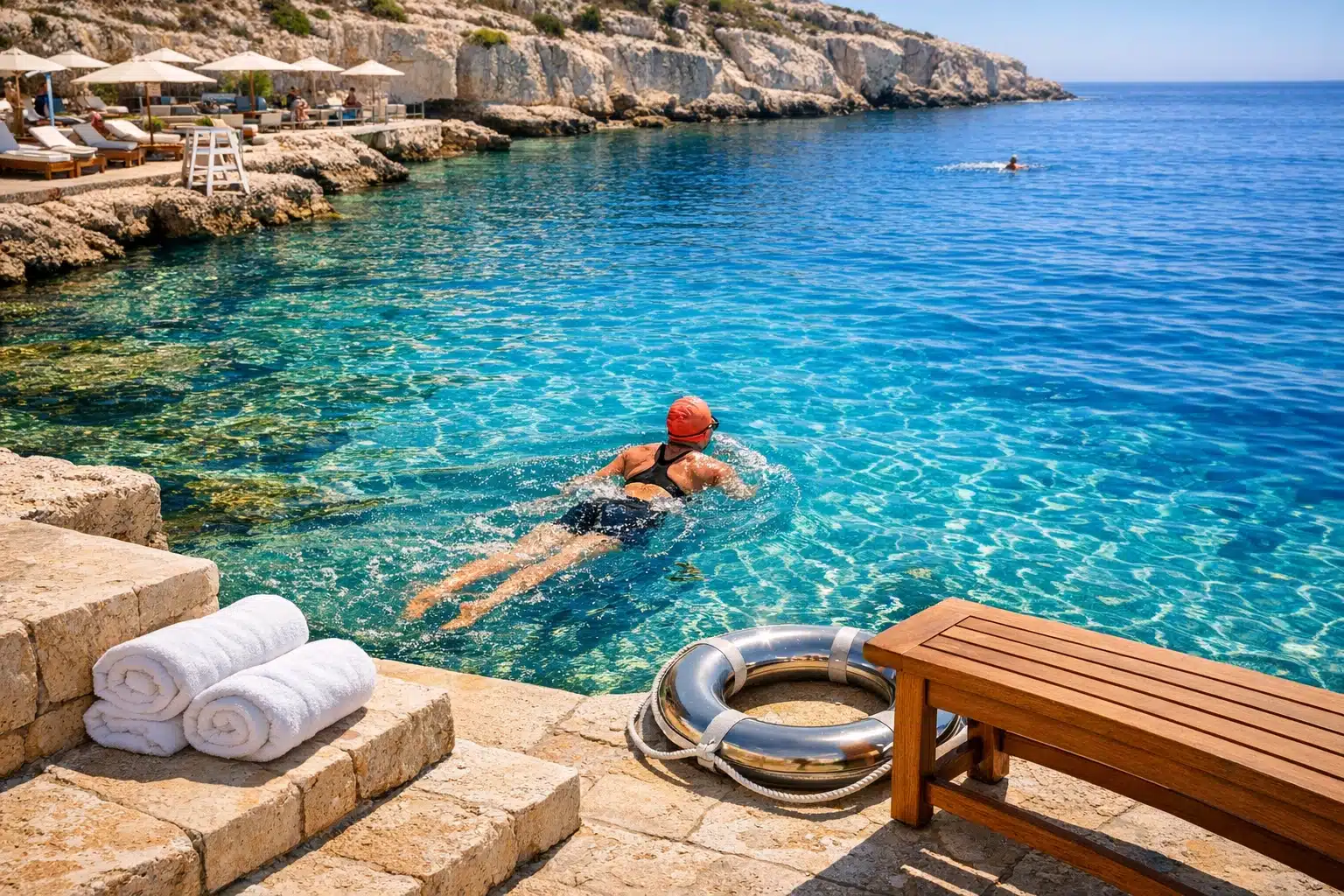
Pool swimming and open-water swimming also require different preparation. In the pool, walls provide frequent breaks, lane lines help with direction, and the environment is controlled. Open water adds sighting, waves, currents, temperature changes, and reduced visibility. A capable pool swimmer may still feel unsettled in a lake or the sea, so transition should be gradual and supervised.
For steady improvement, a few habits help greatly:
- Swim regularly, even if sessions are short.
- Track simple measures such as distance, pace, or perceived effort.
- Film technique or seek coaching when possible.
- Increase workload gradually rather than chasing instant results.
Perhaps the most useful training lesson is this: swimming rewards patience. Progress may arrive quietly. A lap feels smoother, breathing stops feeling rushed, turns become less chaotic, and the once-intimidating deep end starts to feel ordinary. Those changes may look small on paper, but in the water they add up to confidence, efficiency, and lasting improvement.
A Practical Conclusion for New and Returning Swimmers
If swimming is going to remain a lifelong activity, safety and good habits must sit alongside fitness goals. Strong technique is valuable, but sound judgment matters just as much. This is especially true outside the pool, where weather, visibility, temperature, and currents can change quickly. Open water has its own beauty, yet it never rewards carelessness. Even experienced swimmers benefit from simple rules such as checking conditions, swimming with others, and respecting personal limits.
Water safety begins with fundamentals. Children should learn under qualified supervision. Adults who are unsure in deep water should not be embarrassed about starting with beginner lessons. Comfort in water is built, not magically inherited. Knowing how to float, tread water, roll onto the back, and exit safely from the side of a pool can be as important as learning a fast freestyle. Confidence should grow from skill, not from guesswork.
In shared pools, etiquette improves the experience for everyone. Circle swimming in the correct direction, letting faster swimmers pass, resting at the lane corner rather than the middle, and being aware of space all make sessions smoother. These habits may sound minor, but they shape the atmosphere of a facility. A good pool feels almost like a quiet community workshop: each swimmer working on something personal while still cooperating with the group.
Swimming also stands out because it can remain relevant across a lifetime. Young athletes may chase times and medals. Busy adults may use the pool for stress relief or conditioning. Older swimmers often appreciate the freedom of moving with less joint pressure. Some people join masters programs, some train for triathlons, and others simply enjoy the reliable rhythm of morning laps. The beauty of swimming is that it does not demand a single identity from the person doing it.
For readers who are curious but hesitant, the next step does not need to be dramatic. It can be modest and practical:
- Book one lesson or attend one supervised session.
- Choose simple goals, such as floating comfortably or swimming two relaxed lengths.
- Invest in basic gear that fits well.
- Focus on control before speed.
The world of swimming is wide enough for competitors, cautious beginners, fitness seekers, and people who simply enjoy the feel of water after a long day. That is why it continues to matter. It offers exercise without harsh impact, skill without age limits, and challenge without needing spectacle. For most readers, the best reason to begin is not to become extraordinary. It is to become more capable, more confident, and more at ease in a place that once felt unfamiliar.