Explore the world of swimming
Swimming is one of the few activities that feels playful while demanding real skill, patience, and body awareness. It matters in everyday life because it can build fitness, support recovery, teach water safety, and open the door to recreation or competition at almost any age. From steady laps in a neighborhood pool to the thrill of open water, it blends technique with freedom in a way few sports can match. This article maps the essentials, then dives into the details.
Outline: Why Swimming Matters and What This Article Covers
Swimming deserves more attention than it often gets because it sits at the intersection of sport, health, survival skill, and leisure. A child may first meet it through playful splashing, an adult may return to it after an injury, and an athlete may chase fractions of a second in the pool. Few activities can move so easily between those worlds. Water changes how the body works: it supports weight, adds resistance, and forces a different rhythm of breathing. That alone makes swimming worth studying, not just doing.
Before moving into the finer points, it helps to see the structure of the subject. This article is organized around five practical areas:
– why swimming matters in everyday life and sport
– how the main strokes differ in technique and purpose
– what swimming can do for fitness, health, and mental well-being
– how pool swimming compares with open water and competitive formats
– what beginners and returning swimmers should know about safety, gear, and steady progress
That outline matters because swimming is often misunderstood in two opposite ways. Some people treat it as nothing more than casual recreation, while others imagine it as an elite sport reserved for trained athletes. The truth sits in the middle. Swimming can be gentle enough for rehabilitation and demanding enough for Olympic competition. It can be solitary, social, meditative, technical, or fiercely competitive depending on the setting. A slow breaststroke session and a butterfly sprint are both swimming, yet they place very different demands on the body and mind.
There is also a broader human reason to care about it. Water has shaped settlement, travel, work, and recreation for thousands of years. Learning to move through it safely is not just a hobby; it is a practical life skill. For parents, swimmers, coaches, and health-conscious readers, the topic carries real relevance. The sections that follow move from the big picture into the mechanics, then toward benefits, environments, and action steps. Think of this opening section as the poolside map before the first length begins.
Swimming Technique: Strokes, Efficiency, and the Art of Moving Through Water
Swimming looks smooth when done well, but that smoothness is earned through coordination. Water offers far more resistance than air, so even small technical mistakes can waste energy quickly. A dropped elbow, a late breath, or a kick that breaks body alignment may not seem dramatic, yet over several lengths those details add up. Efficient swimming is not about thrashing harder. It is about reducing drag, directing force cleanly, and matching breathing to movement.
The four competitive strokes each have a distinct personality. Freestyle, usually swum as front crawl, is generally the fastest and most common for fitness training. Its alternating arm action and flutter kick allow continuous forward motion, which is why beginners often learn it early. Backstroke shares a similar alternating pattern, but the swimmer faces upward, which removes the challenge of turning the head to breathe while introducing the challenge of swimming straight without looking ahead. Breaststroke is slower for most swimmers, yet it feels approachable because the head can rise naturally and the stroke has a clear glide phase. Butterfly is the most technically demanding of the four, combining simultaneous arm recovery with a dolphin kick and a wave-like body motion that rewards timing and punishes inefficiency.
Several principles connect all strokes:
– a long, balanced body position usually reduces resistance
– controlled breathing supports rhythm better than rushed gasps
– propulsion works best when the hands and feet push water backward with purpose
– timing matters as much as strength
– relaxation is not laziness; it is energy management
Freestyle offers a good example of technical layering. A beginner may focus first on floating flat, then on exhaling underwater, then on turning the head just enough to breathe, and only later on details like catch position and kick tempo. The stroke improves in stages. Breaststroke, by contrast, depends heavily on timing: pull, breathe, kick, glide. If one part arrives too early or too late, momentum fades. Backstroke challenges posture and shoulder control, while butterfly demands core strength and precise sequencing more than brute force alone.
Technique also shapes enjoyment. A swimmer who learns to streamline off the wall, hold a steady pace, and breathe without panic often discovers a strange and satisfying sensation: the water stops feeling like an obstacle and starts feeling like a partner. That is when swimming becomes more than exercise. It becomes craft.
Health and Fitness Benefits: What Swimming Can Do for Body and Mind
Swimming is often praised as a full-body workout, and that description is fair, though it hardly captures the whole picture. Because the body works against water resistance from multiple angles, swimming recruits the shoulders, back, chest, core, hips, and legs in one continuous pattern. At the same time, buoyancy reduces impact on the joints, which is one reason swimming is frequently recommended for people who want exercise without the repetitive pounding associated with some land-based activities. That does not make it easy. It simply makes the stress different.
For general health, swimming can contribute to the same broad goals as other aerobic exercise. Public health guidance commonly advises adults to aim for at least 150 minutes of moderate-intensity activity per week, and swimming can count toward that target. Regular sessions may help improve cardiovascular endurance, support healthy weight management, and strengthen muscular endurance. The exact effect depends on stroke choice, intensity, duration, and individual fitness level. A relaxed recovery swim feels very different from interval training, and the body responds accordingly.
Compared with running, swimming usually places less impact on knees and ankles. Compared with cycling, it often asks for more coordinated upper-body involvement. Compared with gym machines, it demands a stronger relationship between breathing and movement. Those differences help explain why swimmers often develop not only endurance, but also a sharpened sense of timing and body awareness. When breathing is mistimed, the stroke immediately reveals it.
The mental side matters just as much. Many swimmers describe the pool as a place where noise fades. Repeated lengths create rhythm, and rhythm can be calming. The soundscape narrows to bubbles, splashes, and the muffled world beneath the surface. For some people, that brings stress relief. For others, it provides structure after a chaotic day. Even recreational swimming can improve mood simply by combining movement, breath control, and sensory reset.
Its benefits are especially valuable for a wide range of people:
– older adults looking for joint-friendly activity
– recovering exercisers returning after injury
– children building coordination and water confidence
– competitive athletes using swimming for conditioning
– busy adults who want efficient, whole-body exercise
None of this means swimming is automatically suitable in every case. Technique problems, shoulder overuse, or poorly supervised environments can create setbacks. Still, when approached thoughtfully, swimming offers a rare blend of challenge and accessibility. It asks a lot from the body while often feeling kind to it, and that balance is a large part of its appeal.
Where Swimming Happens: Pools, Open Water, Competition, and Everyday Culture
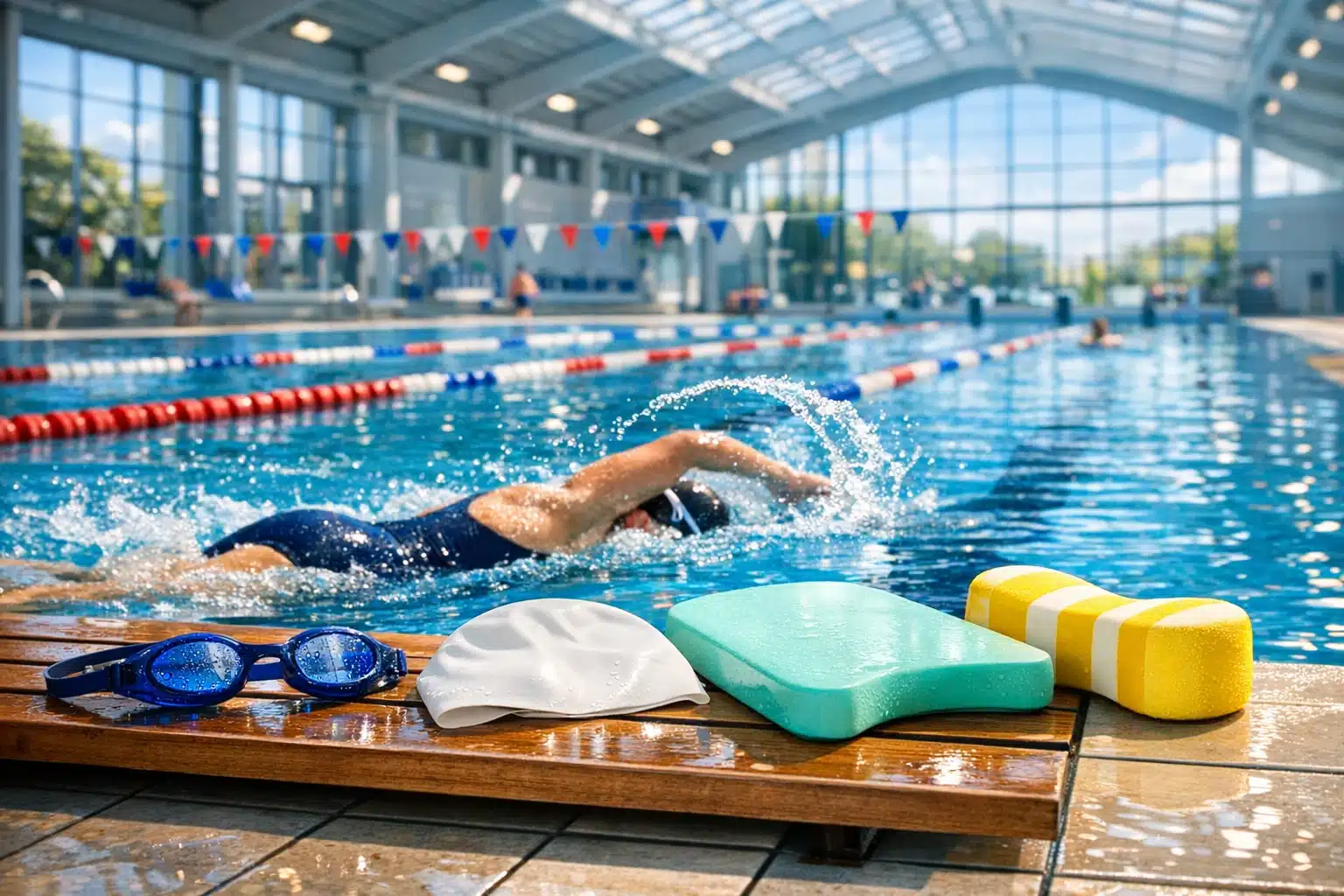
Swimming changes character depending on where it happens. In a pool, the environment is measured, marked, and controlled. Distances are known, walls arrive on schedule, and lane lines help organize movement. Standard short-course pools are typically 25 meters or 25 yards, while Olympic pools are 50 meters long. That predictable setting makes pools ideal for lessons, structured training, and performance tracking. A swimmer can count strokes, record split times, and compare today’s effort with last week’s session in a precise way.
Open water is another story entirely. Lakes, rivers, and oceans remove the tidy geometry of the pool and replace it with current, temperature changes, waves, visibility issues, and navigation demands. The skill set shifts. A pool swimmer may be technically polished and still feel surprised by how different open water feels. There is no black line on the bottom, no wall every few seconds, and often no complete stillness. Sighting becomes essential, pacing must account for conditions, and safety planning matters even more. Yet many swimmers are drawn to open water precisely because of that uncertainty. It feels expansive, less mechanical, and occasionally exhilarating in a way the pool cannot imitate.
Swimming also lives in many cultures at once. It is a school activity, a family pastime, a lifesaving skill, a rehabilitative tool, and a global sport. Competitive swimming includes sprint events, middle-distance races, relays, medleys, and long-distance open-water events. Beyond elite competition, there are masters programs for adults, community lessons for beginners, triathlon clubs, and para-swimming pathways that widen access. The sport is more inclusive in structure than many people assume.
Even the social rules tell a story. Lane etiquette in public pools teaches awareness and shared space. Swimmers learn when to circle, when to pass, and how to respect different speeds. Beaches and open-water venues teach a different kind of responsibility: reading flags, understanding weather, and never mistaking confidence for safety.
Each setting offers something valuable:
– pools reward consistency and measurable progress
– open water builds adaptability and environmental awareness
– competition sharpens goals and technique
– recreational swimming keeps movement enjoyable and sustainable
Together, these worlds explain why swimming remains relevant across ages and lifestyles. It is not confined to one building, one goal, or one kind of athlete. It travels well between serious training and simple joy.
Getting Started Safely and Final Thoughts for New and Returning Swimmers
For beginners, the biggest mistake is often trying to swim harder before learning to swim better. A short, controlled session with good breathing and body position is usually more useful than a longer struggle full of tension. Starting well means respecting the learning curve. Water confidence, floating control, breathing rhythm, and basic stroke mechanics deserve time. Progress may look modest at first, but swimming has a way of rewarding patience. A person who once stopped after one length may, a few months later, move steadily through an entire session with calm concentration.
A simple beginner setup is enough:
– a comfortable swimsuit that stays secure in motion
– goggles with a proper seal
– a swim cap if desired or required
– a kickboard or pull buoy for selected drills, not constant dependence
– access to a supervised pool or qualified instruction when possible
Safety deserves equal attention. New swimmers should avoid practicing alone, especially in deep water or unfamiliar environments. Open-water swimming requires extra caution because conditions can shift quickly. Temperature, visibility, waves, and currents all matter. Even strong swimmers benefit from using designated areas, swimming with others, and checking local guidance before entering natural water. Pool users, meanwhile, should learn lane rules, warm up gradually, and stop if sharp pain or dizziness appears. Confidence is helpful; overconfidence is dangerous.
Training can remain simple at first. Two or three sessions per week is enough for many adults to build skill and fitness. One session might focus on drills and breathing, another on short repeats with rest, and a third on relaxed continuous swimming. Improvement comes from consistency more than heroics. Keeping a basic log of distance, stroke choice, and how the session felt can reveal progress that memory alone misses.
For readers wondering whether swimming is “for them,” the answer is broader than many expect. If you want a low-impact workout, a practical life skill, a structured sport, or a peaceful way to reset after work, swimming offers an entry point. Parents can value it as water competence, fitness seekers can use it as conditioning, and former swimmers can rediscover it without needing to chase old times. The best reason to begin is not perfection. It is possibility. Step into the water with curiosity, learn the fundamentals, and let steady practice do what sudden ambition rarely can: build real confidence that lasts.